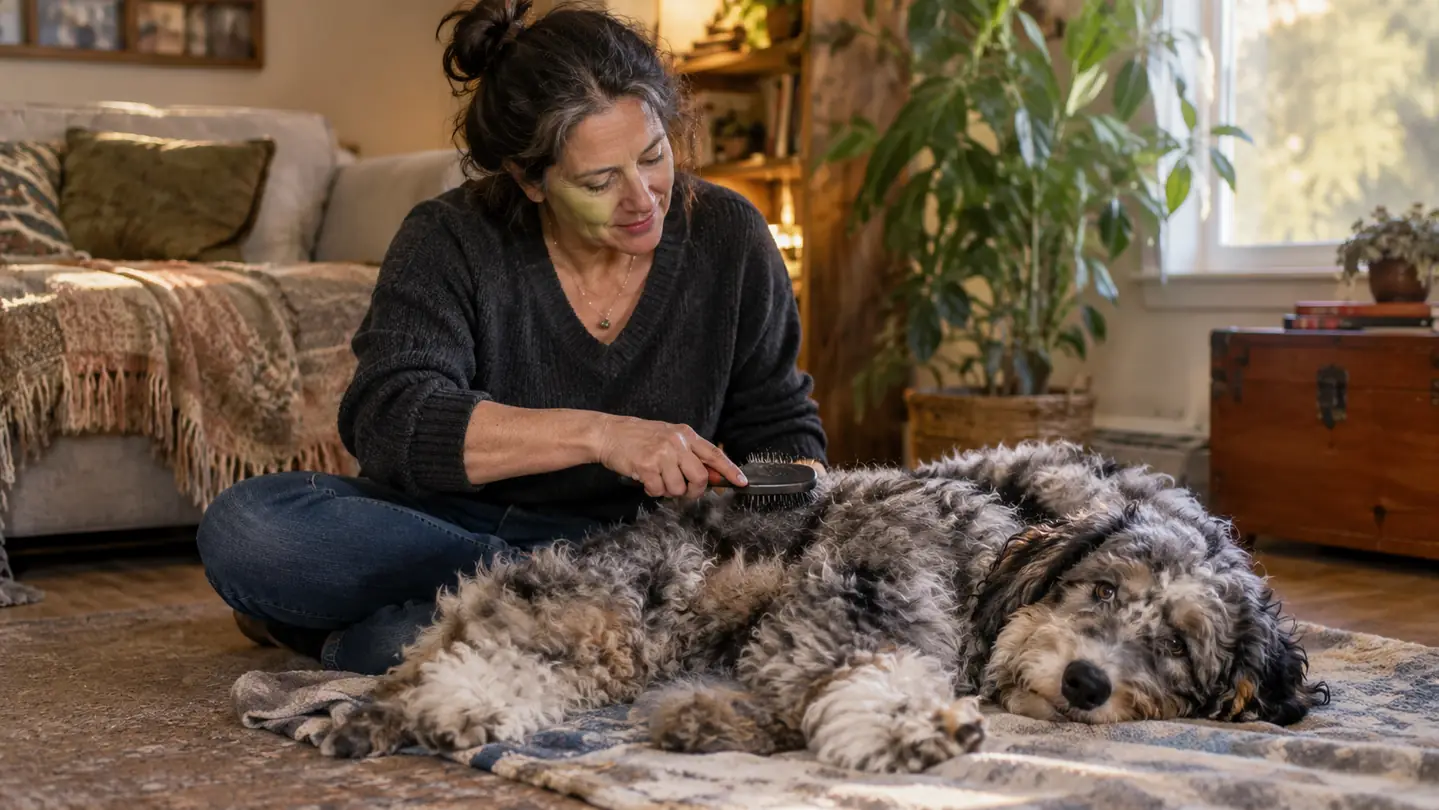
Every Aussiedoodle owner has the same moment. You run your fingers through that beautiful wavy coat, hit something behind the ear, and realize it is not a curl, it is a mat. I had that moment with June when she was about six months old, right as her puppy coat started changing. The mat was small and tucked behind her left ear, and by the time I found it, brushing anywhere near it made her flinch. That same week I ordered the Chris Christensen Big G Slicker Brush, and it is a big reason June, now a three year old blue merle with a wavy-curly coat, has never been shaved down.
Let me be honest about what this article is and is not. I am a dental hygienist who owns one very curly dog. I am not a groomer, and I have no interest in pretending otherwise. Everything I know about mats I learned on the living-room floor with a dog who would rather be fetching. If a mat is tight, felted, or sitting close to the skin, I do not try to brush it out. That is a job for a professional. June sees her groomer about every eight weeks for a bath and a trim, and I do the brushing in between. This article is about the everyday routine that stops mats from forming in the first place. It works for June. I believe it can work for your Aussiedoodle too.
Start with the slicker that reaches the skin without scraping it
The Chris Christensen Big G has long, flexible pins on a cushioned pad, so it glides through June's coat down to the skin without scratching. It is the tool that got her through her first coat change, and it is still the one I reach for three or four evenings a week. See today's price on Amazon.
Amazon Check Today's Price on Amazon →Step 1: Set up on the floor with a dry coat and a light mist
June's routine happens on the living-room floor, with an old towel that she knows means brushing time. Most nights she walks over and flops down before I even pick up the brush. She lies on her side and mostly stays put, especially when she knows a treat is coming at the end. The towel keeps the brush from picking up carpet lint, and it gives me a clear path from her head to her tail. I keep the Chris Christensen Big G, a plain steel comb, and the spray bottle in a basket on the shelf by the back door, so everything is ready when we are.
One rule I learned the hard way: never brush a wet coat. Water makes curls tighter, and tighter curls mean more tangles. I only brush June when her coat is dry or barely damp, and I start with a light mist of TropiClean Detangler Spray over one section at a time. It is a leave-in conditioning spray with a sweet, fresh scent, and it adds enough slip that the brush glides instead of catching. I use it mostly behind her ears, along the collar line, and in her armpits, because those are the spots where June's mats always start. The spray does not dissolve a felted mat. Nothing does, short of the groomer's clippers. What it does is give me a head start on the knots that are still loose.
Step 2: Brush in small sections, line by line, down to the skin
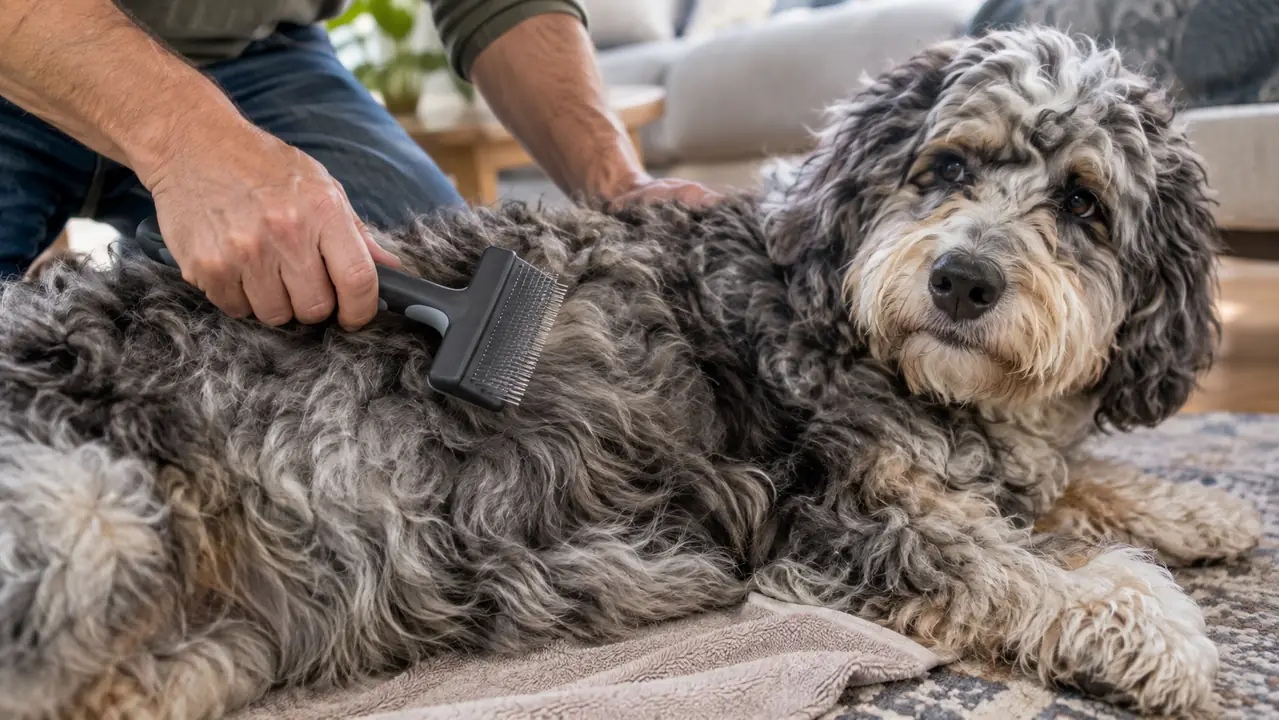
The biggest mistake I made with June's first brush was trying to brush the whole coat top to bottom like it was a flat surface. A curly coat does not work that way. The curls tangle with each other, and a fast pass over the top just smooths the outside while the mat stays hidden underneath. The fix is line brushing. I part the hair with my fingers or the comb, lift a small section, hold it gently at the base, and brush that section from the skin out to the tips. Then I move to the next section, an inch or so over, until I have covered the whole body.
June has a good attention span for brushing, but she is still a dog, and a smart one. I keep a few small treats nearby and give her one every few minutes, especially when she holds still for the tricky sections. The treats are not bribery so much as a reminder that brushing is a boring thing that ends in something good. When she starts to squirm, I stop and let her shake it off, then we go back to it. Forcing a wiggly dog through a brushing session just teaches her to hate the brush, and that is the last thing I want.
The Chris Christensen Big G is built for this. Its long, flexible pins sit on a cushioned pad, so when I use a light hand, the pins reach the skin without scraping it. The coral handle is light, and the cushioned pad means the pins give a little instead of digging in. That matters, because the point of line brushing is to work the tangle out at the root, not just fluff the surface. I let the brush do the work and keep my pressure light. When I press too hard, June shifts and sighs, and that is my signal to ease up. A slicker is a tool, not a force. If I have to pull, I am either holding the hair at the base wrong or the section is more knot than coat.
Step 3: Hit the mat zones first, then do the rest
Every Aussiedoodle has a map of trouble spots, and June's is printed on me by now. Behind her ears, where the hair is soft and fine. Her armpits, where the rabbitgoo harness strap rubs on walk days. And the collar line, where her collar used to sit before we switched to the harness. Those three zones are where June's mats show up first, and they are where I start every brushing session, before I move to her back and legs. If I do the easy parts first, June gets impatient by the time I reach the hard parts. Starting with the mats means she is at her calmest when the brushing matters most.
When I reach a tangle, I do not attack it head on. I work around the edges first, brushing the loose hair above and below it, then I go back and gently work the knot itself from the outside in. Most of the time it comes apart in a few passes. If a section will not budge, I stop. A tight mat that sits close to the skin is not something I fix at home, because the skin under a felted mat is tender and easy to nick with a pin. Tight mats go to the groomer, and June's groomer has never once made me feel bad about bringing one in. I also check the skin as I go. If anything feels bumpy, sore, or irritated, that is a conversation for the vet, not the brush. Better a small mat for the groomer than a shave-down for June.

Step 4: Follow every section with a steel comb
The slicker gets the coat looking smooth, but the comb is the part that actually catches the trouble. After I finish a section with the Chris Christensen Big G, I run a plain steel comb through the same section, from the skin out. The comb has a different job than the slicker. Its teeth are close together, so it finds the tiny knots the slicker glides over, the ones that would become tomorrow's mats. When the comb passes through without snagging, that section is done and I move on. When it catches, I go back with the slicker and work that spot again.
I did not always do the comb check, and I can tell you exactly what happens without it. The coat looks brushed. It feels soft on top. And two days later, there is a mat behind June's ear that was not there before, because the slicker had smoothed the surface while a small knot tightened underneath. The comb is the difference between brushing that looks done and brushing that is done. It is also how I know when a section is truly finished. If the teeth run through with a clean sound, no catching, no tugging, I close that section and move on. It does not add much time. Maybe a few extra minutes across the whole dog. But it cut the number of mats I find between groomer visits down to almost none.
Step 5: Keep a rhythm, and know when to stop
June gets brushed three or four evenings a week, for fifteen to twenty minutes at a time. That rhythm matters more than any single long session. A curly coat is always working its way toward a mat, and a little brushing several times a week keeps the knots from ever getting a foothold. Even on busy weeks, I try to at least run the comb through her ears and collar line, because those are the spots that turn into mats fastest. I do not try to do a perfect full groom every session. Some evenings I focus on the mat zones and the high-tangle areas. Other evenings I do the whole dog. The goal is consistency, not perfection.
The other half of knowing when to stop is knowing when a mat has won. If a knot is tight, felted, or so close to the skin that I cannot get a comb under it, I leave it alone and let the groomer handle it. June sees her groomer about every eight weeks, and because I brush in between, the groomer has never had to shave her down. That is the whole point of the routine. It is not about being the best brusher in the world. It is about showing up a few evenings a week with the right tool and a light hand, so the groomer gets a dog with tangles instead of a dog with felts. A shave-down is not the end of the world, but the coat takes months to grow back.
What Else Helps
Three things make the routine easier than it sounds. First, an old towel. June lies on the same towel every time, and it is part of the signal that brushing is happening. Second, a steel comb you actually like using. Mine has no brand name on it, it is just a plain comb I have had for years, and it is the tool that catches the knots the slicker misses. Third, a schedule. Three or four evenings a week, on the living-room floor, after dinner, before the couch. The schedule works because it is boring, and boring is easy to repeat. The routine does not work if it only happens when I remember. And one more note: after a walk in the rabbitgoo harness, I check June's armpits and chest, because the strap line can rub curls into tangles. A minute of brushing there saves me a mat later.
One more thing that helps, and you do not need to buy anything for it: ask your own groomer to show you how they brush. Watching a professional line-brush a curly coat in person teaches more than any video. Groomers also know what a healthy coat should feel like, and they can tell you if a spot that keeps matting is worth a vet visit. I am not a groomer or a vet, so when something looks wrong, I ask mine.
June is three, her coat mats behind the ears and along the collar line, and she has never been shaved down. The comb finds the knots before they ever tighten.
Every Aussiedoodle owner has that moment when a finger finds a mat and the stomach drops. I have had it more times than I can count. The difference now is that I have a routine, and the routine catches the knots before they become a shave-down. If you are just starting out, be patient with yourself. The first few sessions are clumsy. The dog fidgets. You miss spots. Keep going. A few weeks in, the whole thing takes fifteen minutes, the comb glides through, and you will wonder why it ever felt hard. And if you hit a mat you cannot beat, call the groomer. That is not failure. That is just being a good owner.
The brush that got June through her coat change and every coat change since
If you are tired of finding mats and dreading the shave-down, start with the Chris Christensen Big G Slicker Brush, a detangler spray, and a steel comb. Then keep the rhythm going three or four evenings a week. That routine is the whole story. See today's price on Amazon.
Amazon Check Today's Price on Amazon →