
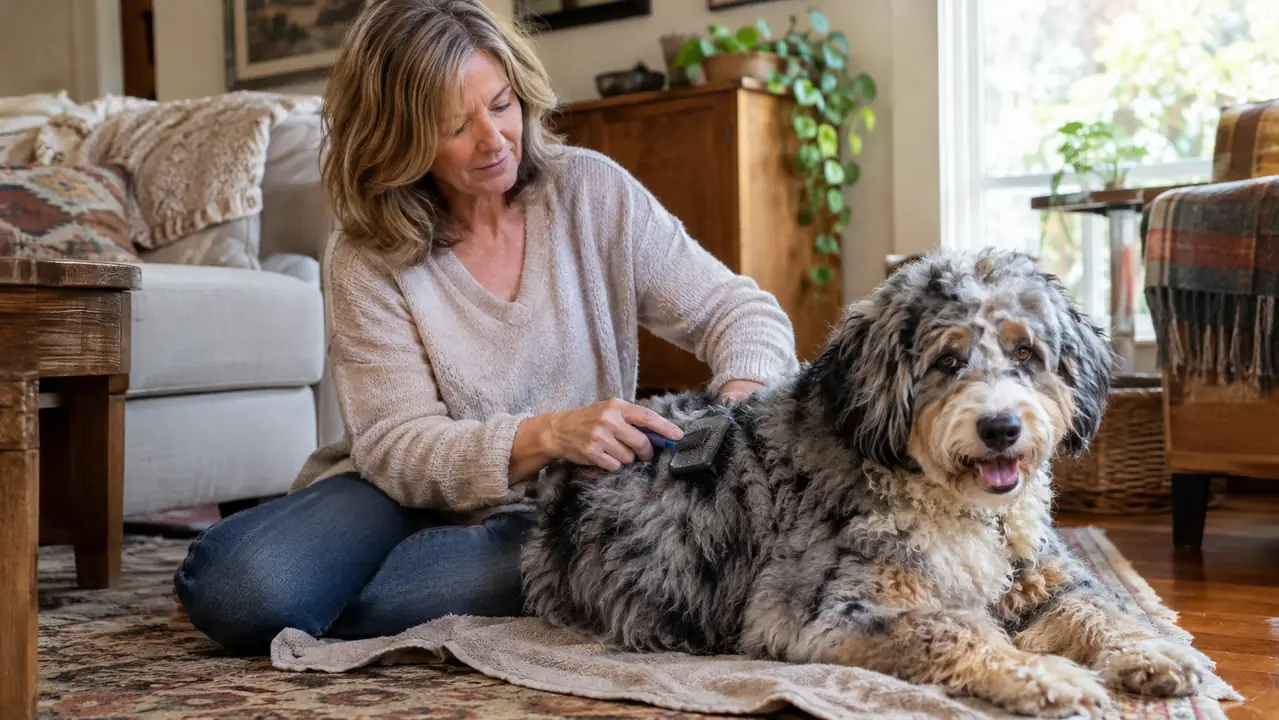
If you have an Aussiedoodle, you already know the coat is the job. June, our three-year-old standard Aussiedoodle, has a wavy-curly blue merle coat that mats behind her ears, in her armpits and right along her collar line. For the first few months she was home, I fought those tangles with a cheap pin brush and a lot of tugging. She hated it, I hated it, and the groomer kept finding mats I had missed. Then I added the TropiClean Dog Detangler Spray to the routine, and brushing went from a battle to about fifteen quiet minutes on the living room floor.
This is the exact routine I use, step by step, for anyone who is tired of wrestling a curly coat. I am not a groomer, so if your dog has a tight, felted mat or any skin irritation, ask your groomer or vet. But for the everyday tangles that show up between grooms, this works.
The spray that made brushing June tolerable
TropiClean Dog Detangler Spray adds slip to a wavy-curly coat so the brush glides and knots loosen instead of pulling. It is the bottle I reach for three or four evenings a week.
Amazon Check Today's Price on Amazon →Step 1: Start with a dry or barely damp coat
The TropiClean Detangler Spray is a leave-in conditioning spray, not a bath product. I use it on June when her coat is dry or barely damp, never right after a bath. A wet coat tangles faster and the spray does not spread the same way on soaking fur. If June has been out in the rain or had a drink that ended up all over her chest, I let her air dry for a bit before I start.
I also make sure she has had a good run first. June is forty-eight pounds of bounce, and trying to brush a dog that has not burned off energy is a losing game. A quick backyard fetch or a short walk means she is happy to lie on her old towel while I work. The towel matters too. It catches loose hair, keeps the spray off the rug, and gives her a clear signal that this is brushing time.
Before the spray even comes out, I run my hands over her the way you would check a kid for a fever. I start at her head, go behind each ear, down the neck, under the front legs, along the belly and back up over her hips. Anything that feels like a little lump of cotton gets a mental note. That two-minute pat-down tells me where to spend my time, so I am not brushing the easy parts of her back for ten minutes while the real problem sits in her armpit. It also gives June a calm start. By the time the bottle and the brush appear, she has already settled into being handled, and she usually lets out a big sigh and flops over.
Step 2: Mist a section, not the whole dog
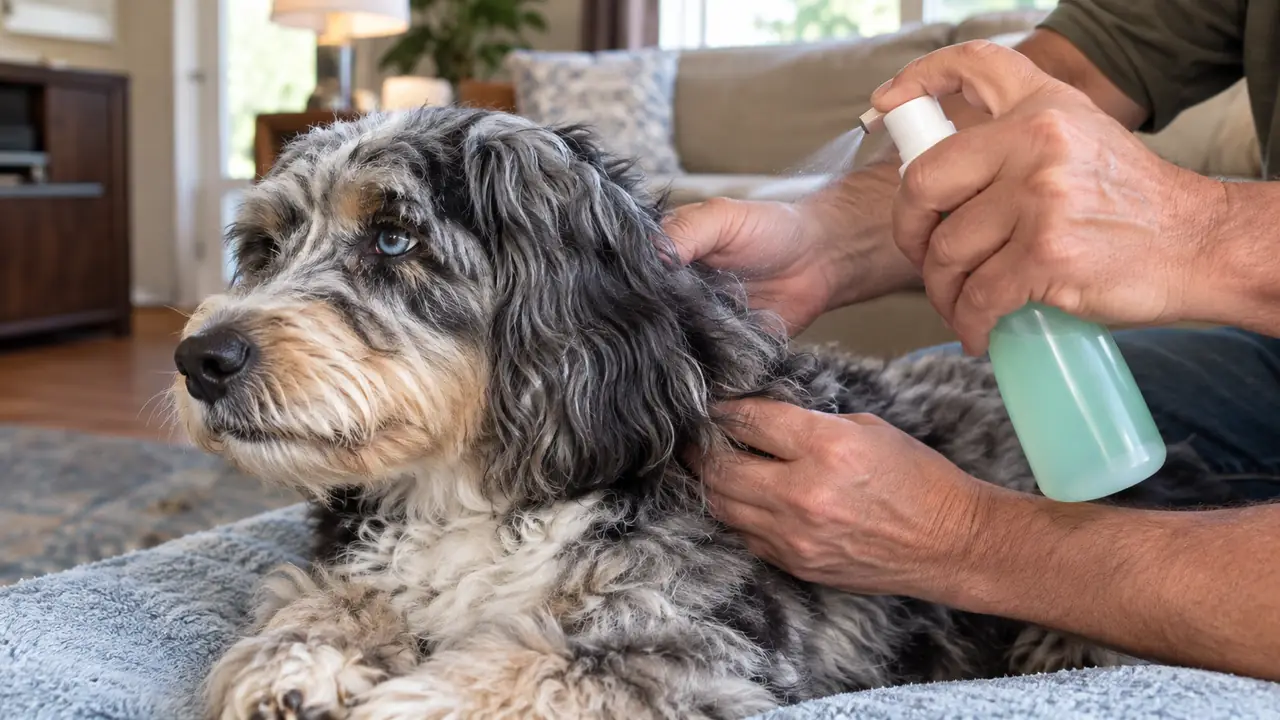
Here is the mistake I made at first: I sprayed June all over and then tried to brush her like a normal dog. That does not work on a coat like hers. The spray needs a moment to soak into the fur, and by the time I got to the other side of her, the first section had already dried. Now I work in small sections, the way my groomer showed me. I lift a section of coat with one hand, give it a light mist underneath, and move on to the next spot.
The TropiClean spray has a sweet, fresh scent that is pleasant without being overpowering, and it is made in the USA. A little goes a long way. I use a light mist, not a soak. The goal is slip, not wet fur. I focus on the places June actually mats: behind her ears, in her armpits and along her collar line. Those are the spots where the curls rub together and knot up, and they are exactly where the spray earns its keep.
Section size took me a while to get right. When I tried to work a patch as wide as my whole hand, the spray sat on top of the curls and never reached the knots near the skin. Now I lift a strip of coat about as wide as two fingers, flip it up so I can see the skin underneath, and mist the hair right at the base of that strip. Then I let the coat fall back and lift the next strip just below it. It feels slow the first few times. After a week or two it becomes automatic, and I actually finish faster because I am not going back over the same tangles three times.
Step 3: Brush in small sections with a slicker brush
Once a section is misted, I brush it with the Chris Christensen Big G Slicker Brush, the large one with the coral handle. It has long, flexible metal pins on a cushioned pad, and it reaches down to the skin without scraping when I use a light hand. I brush in small sections, holding each section up and brushing from the skin outward with short, light strokes. That matters. Long, hard strokes that drag through the whole length just pull a knot tighter, and the dog learns to hate the brush.
June lies on her side while I work down her body, then rolls over so I can do the other side. I brush three or four evenings a week, fifteen to twenty minutes at a time. The spray gives the brush enough slip that the pins glide through the curls instead of catching. When I hit a small knot, I hold the hair above it with my fingers so the pull stays on the knot, not on her skin, and work it loose gently. If a knot will not budge, I leave it for the groomer. The spray loosens tangles, it does not dissolve a solid mat.
Pressure is the other thing I had to learn. A slicker brush with long metal pins can scratch if you lean on it, and June will tell you about it by turning her head and giving the brush a hard stare. I hold the handle loosely, almost like a pencil, and let the pins do the work. If I see any pink skin or redness, I stop on that spot for the night. Brush burn is real, and it can turn a dog against brushing for weeks. When something on her skin looks irritated, that is a question for the vet, not something I try to brush through or cover with more spray.
Step 4: Check your work with a steel comb
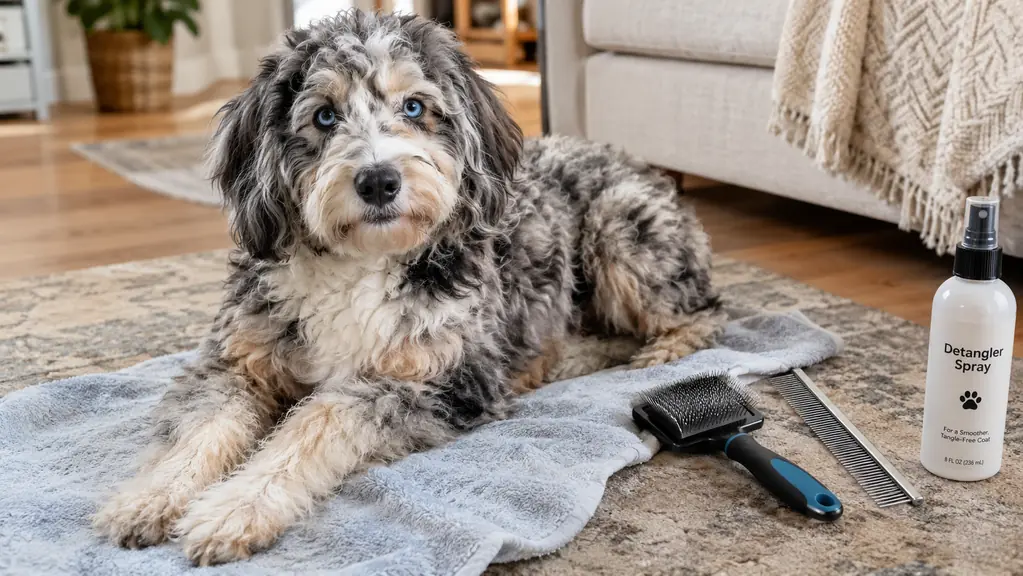
The slicker gets the coat looking smooth, but the comb is the honest check. I run a plain steel comb through each section after I brush it. The comb finds the tiny tangles the slicker missed, especially right behind the ears and in the armpits. If the comb catches, I mist that spot again, give it a few seconds, and brush it once more. If the comb glides through, that section is done.
This is the step most people skip, and it is the one that keeps June from getting shaved down at the groomer. My groomer sees her about every eight weeks for a bath and a moderate trim, and she has never had to shave June. That is not luck. It is the comb. A slicker can smooth the top of a mat while the tangle stays hidden underneath, and the comb is what catches it before it becomes a problem.
I also look at timing. The worst mats I ever found on June showed up right after a stretch of rainy weeks when I skipped brushing because she was damp all the time. Now, if she has been wet, I towel her off, let her dry in her bed, and still do a short session on the trouble spots that evening, even if I only get to her ears and armpits. Ten minutes on the hard areas is better than nothing. The rest of her coat can wait a day. The places that rub never can, and they are the places a groomer will have to clip short if they get away from you.
Step 5: Brush the spots the harness rubs
One thing I learned the hard way: the strap line of June's rabbitgoo No Pull Harness rubs her chest and armpits on every walk, and all that rubbing rolls the curls into tangles. I walk June about forty-five minutes most mornings, and by the end of the week those spots are the worst part of her coat. So after every walk, I give her chest and armpits a quick once-over with the spray and the slicker. It takes two minutes, and it stops the tangles before they start.
The same idea applies to her collar line. Anything that rubs the coat all day is going to create friction, and friction creates mats. A light mist of the TropiClean spray on those spots before brushing keeps the brush gliding. I keep the spray, the slicker and the comb in a basket on the shelf by the back door, so the whole routine is right there when we come in from a walk.
What Else Helps
The spray is the piece that made brushing easier, but it is not the whole routine. The slicker does the actual detangling, the comb catches what the slicker misses, and the harness choice matters more than I expected. If you are starting from scratch, get a slicker with long, flexible pins, a steel comb, and a detangler spray that adds slip. Then build the habit: three or four short brushing sessions a week beat one long, miserable session on Sunday. And when a mat is tight enough that you cannot work it loose with your fingers, do not keep pulling. That is a job for your groomer, and there is no shame in handing it over.
If you are just starting with a curly young dog, my honest advice is to make brushing boring and frequent. I gave June a few small treats on the towel when she was young, kept the first sessions very short, and always ended before she got fidgety. A dog that expects brushing to be a short, calm part of the evening will lie still for it. A dog that only gets brushed when the coat is already a mess learns to dread the brush, and then every session is a fight. The spray helps a lot, but the habit is what keeps an Aussiedoodle coat looking soft between grooms. Ask your groomer to show you the spots your dog mats most; mine did, and it changed everything.
The comb is the honest check. It finds the tiny tangles the slicker missed, and it is the reason June has never been shaved down at the groomer.
Give your Aussiedoodle coat a fighting chance
TropiClean Dog Detangler Spray adds the slip that turns a tugging, miserable brushing session into a quiet fifteen minutes. One bottle lasts me two to three months of three or four evenings a week.
Amazon Check Today's Price on Amazon →