
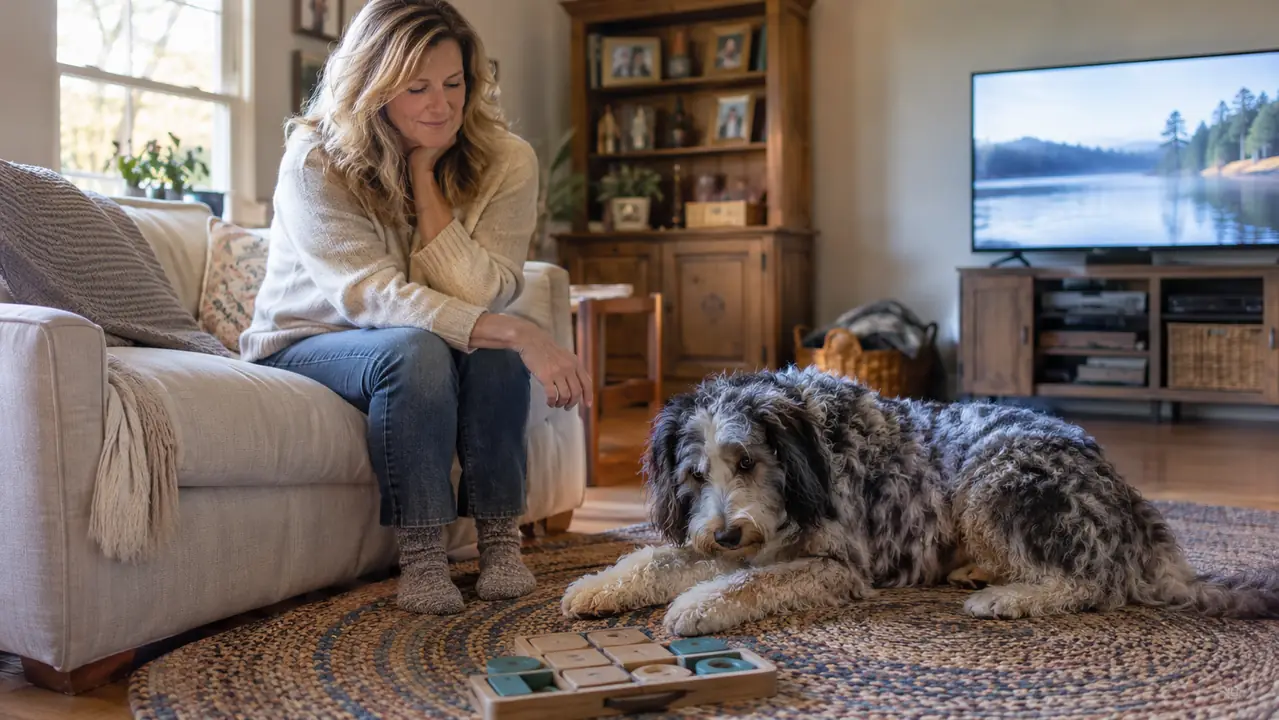
I have a confession about June, our three-year-old Aussiedoodle: a long walk is not enough for her. It never has been. She came home at ten weeks old in October 2023, and by her first birthday I had learned that physical exercise only gets her halfway to calm. When she does not get enough exercise and brain work, she gets restless and chews things she should not. That is how the Outward Hound Nina Ottosson Dog Brick ended up on our living room floor on football Saturdays.
I bought the Brick in September 2024, mostly so Dale and I could watch college football without June finding trouble. Two years later, it is still the first thing I reach for on a rainy day. This is the long-term review I wish I had before I bought it: how the puzzle actually holds up, how fast a smart dog solves it, and the honest limits of a treat puzzle.
The Quick Verdict
A well-made Level 2 puzzle that gives a smart dog a real thinking job. It will not replace exercise, and you will need to change the hiding spots, but two years in, ours still works like new.
Amazon Check Today's Price →A treat puzzle that actually wears out a smart dog
The Outward Hound Nina Ottosson Dog Brick is a Level 2 puzzle with sliding blocks, flip lids and removable bone-shaped pieces. It is well rated on Amazon, and June has used ours for two years. Check today's price.
Amazon Check Today's Price on Amazon →How I've Used It
June gets the Brick on college football Saturdays and on rainy days, always supervised, and it goes back on a high shelf in the hall closet when she is done. That has been the rhythm since September 2024. I will be straight with you: it is not a daily ritual. It is more like a couple of sessions most weeks, which over two years adds up to a lot of puzzle time.
The first time I set it up, I tucked treats into the sliding blocks, under the flip lids, and inside the removable bone-shaped pieces. June sat and watched me the whole time, which for an Aussiedoodle is no small thing. She cleared it in about ten minutes. By the end of the first week, she had the basic moves down. Now she works through it in a few minutes, nose first, one paw on a block to hold it still.
The routine looks like this: Dale and I settle in on the sofa, June parks herself on the rug with the Brick between her paws, and for a solid stretch she is completely absorbed. She checks the sliding blocks first, then the flip lids, then the bone pieces. When she finishes, she looks up at us like she just solved a math problem. Then she puts herself down for a nap, which is the highest praise an Aussiedoodle can give.
What the Brick Actually Is
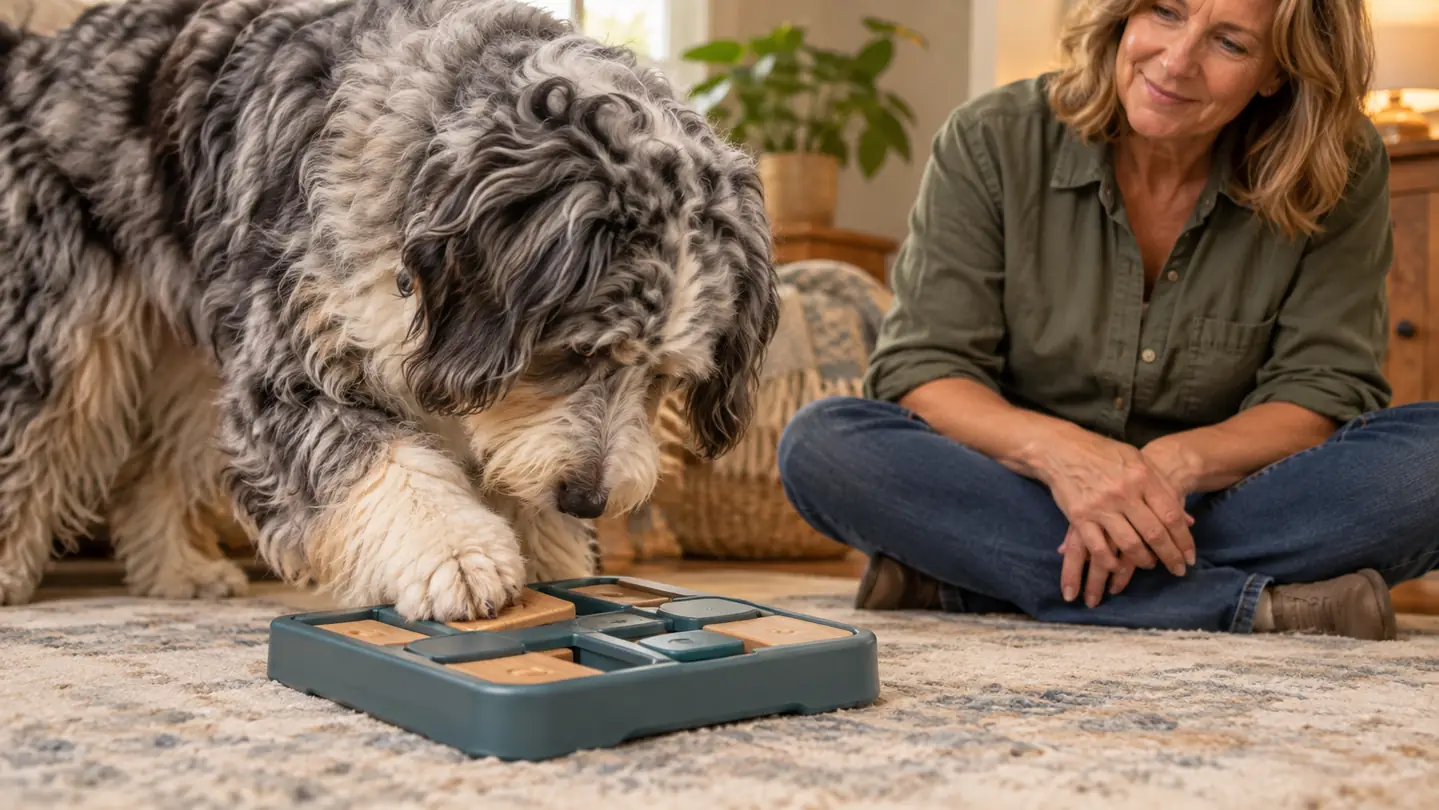
The Brick is a Level 2 puzzle, which in the Nina Ottosson lineup means it is not the easiest starting point. It gives a dog three kinds of moves to figure out: blocks that slide side to side, lids that flip open, and bone-shaped pieces that lift out of their slots. You hide treats in any combination of those spots, and your dog has to work each one to find the reward.
That mix matters more than I expected. A puzzle with only one kind of move teaches a dog one trick, and once they learn it, the puzzle is done. The Brick's three move types mean June has to switch strategies in the middle of a session. Nose work, paw work, then a little problem solving to lift the bone pieces out. It is closer to three small puzzles in one.
If your dog has never tried a treat puzzle, you might start with an easier level before this one. June is a smart, persistent dog, so Level 2 suited her. For a younger puppy or a dog who gets frustrated easily, a simpler puzzle would be a gentler introduction. The Brick is the kind of challenge a confident dog can grow into.
Why a Puzzle Instead of Just Another Walk
Here is what took me a while to learn about a smart dog: tired legs are not the same as a tired brain. June can do a 45-minute walk, come home, drink water, and be ready to find trouble in the living room. A puzzle works different muscles. When she has to sniff, slide, flip and dig for her treats, she comes out of it genuinely settled. That is the difference between a walk and a job.
I have tried the other things you would expect. A longer walk helped, but there are only so many miles in a day. Leaving her with a chew toy kept her busy for a while, but it did not make her think. The Brick asks her to solve something, and solving things is what wears out a clever dog. On a rainy Saturday, it is the difference between a calm afternoon and a dog who cannot settle.
One Saturday last fall, June got the Brick before the early game and then slept through the afternoon slate. Dale noticed before I did. He said it was the calmest she had been on a football Saturday since she was a puppy. That is the effect I am talking about. It is not magic, it is just a dog using her brain until she is genuinely tired.
How It Holds Up After Two Years of Use
The honest question, after months of use, is whether the plastic holds up. Ours has. The blocks still slide the way they did the first month, the flip lids still seat properly, and the bone-shaped pieces still come out and go back in without forcing. I wipe it down after each session, and it looks basically the same as the day it arrived.
The bigger caveat is that it is a puzzle, not a chew toy. I only bring it out when I can watch June with it, and I put it away when she is done. She is not a heavy chewer, so I cannot tell you what a determined chewer would do to it. If your dog mouths everything, do not leave them alone with this one.
The bone-shaped pieces are the part I expected to wear out first, since they get pulled out and pushed back in every session. Ours still fit snugly. I rinse them with the rest of the puzzle under warm water, dry everything, and put the Brick back on the shelf. That two-minute cleanup has kept it looking new.
How I Keep It Interesting
The catch with any puzzle is that a smart dog figures it out. June had the basic moves inside a week, and if I loaded it the same way every Saturday, she would be done before the pregame show ended. So I change it up. Sometimes the treats go in the sliding blocks, sometimes under the flip lids, sometimes inside the bone pieces. Sometimes I use her regular kibble for part of a meal, sometimes a small training treat.
I have also learned to make it slightly harder by mixing the hiding spots in one session, so she has to check everywhere instead of going straight to her favorite spot. That is the real value of a puzzle with more than one kind of move. A snuffle mat hides treats in one way. The Brick hides them in three, and that variety is what keeps June guessing.
Alternatives I Considered
Before I settled on the Brick, I tried a snuffle mat at a friend's house. It is a fine tool for scattering kibble and letting a dog sniff, and I can see the appeal for a puppy. But for June, I wanted more than one kind of challenge, and I wanted something I could put on a shelf when the game was over.
I also considered the free version: folding treats into a towel and letting her unroll it. That worked exactly once before she learned to shake the towel out in five seconds. The Brick has been the better long-term answer because I can change the puzzle, not just the treat. And the Outward Hound name carries real trust with me, and Amazon's star ratings on this puzzle back that up.
The Honest Tradeoffs
No product is perfect, and I do not want to pretend otherwise. The biggest tradeoff with the Brick is that it asks something of you. You have to supervise, you have to reset it between sessions, and you have to keep changing the hiding spots or a smart dog will blow through it and look bored. It is not a toy you can toss in the crate and walk away from.
The second tradeoff is that the Brick is not a substitute for the basics. It does not wear June out the way a trail walk does, and it does not teach her anything about leash manners. What it does is give her a focused mental job on days when the weather or the schedule gets in the way. Think of it as one tool in the drawer, not the whole toolbox.
What I Liked
- Gives a smart dog a real thinking job instead of just a treat to lick
- Three kinds of moves in one puzzle: sliding blocks, flip lids, removable bone-shaped pieces
- Held up well through two years of Saturday and rainy-day use at our house
- Easy to wipe down and easy to put away on a shelf between sessions
- Well rated in Amazon's star ratings
Where It Falls Short
- Supervised use only, and it is not a chew toy
- A clever dog solves the basic moves in the first week, so you have to keep changing hiding spots
- It is a tool, not a replacement for walks, training or time outdoors
- If your dog is not food-motivated, it may not hold their interest
June had the basic moves down in the first week. The reason the Brick still works two years later is that I change where the treats are hiding every single session.
Final Thoughts
Two years in, the Outward Hound Nina Ottosson Dog Brick has earned its place in our Saturday routine. It is not the answer to every dog problem, and it asks more of the owner than a toy you can ignore. But for a smart, food-motivated dog like June, it is the difference between a restless afternoon and a settled one. I would buy it again, and I do not say that about every piece of gear we own. The Brick does one thing well, and for our house, that one thing is worth having around every single Saturday.
Who This Is For
The Dog Brick is for owners of smart, food-motivated dogs who need a job on days when a walk is not enough. If your dog solves a puzzle quickly and then looks at you for another one, this is a good match, as long as you are willing to stay one step ahead with the hiding spots. It is also great for rainy days, busy afternoons, or any time you want a stretch of calm while your dog works for their treats.
I would also recommend it for people who work from home or have busy afternoons and need their dog to settle for a stretch. June is at her best on days when she gets both a morning walk and a few minutes with the Brick. The two together do more than either one alone, and that has been true for two years straight.
Who Should Skip It
Skip the Brick if your dog is a heavy chewer, because this is a puzzle to supervise, not a toy to destroy. Skip it if your dog will not work for food, since the whole point is the treat reward. And if you are hoping a puzzle will replace exercise, training or attention, this is not the answer. It is a tool that helps, not a fix that does the work for you.
I will also be honest about this: if you are looking for something to keep your dog busy while you are out of the house, this is not that thing. The Brick needs supervision, and it is not designed for a dog who chews. For those situations, a long walk and a sturdy chew are the better answer. The Brick is for the times you are home and your dog needs a job.
Give your smart dog a job on the next rainy day
Two years in, the Outward Hound Nina Ottosson Dog Brick is still the first thing I reach for on a rainy Saturday. Amazon's star ratings back that up. If your dog needs brain work, check today's price.
Amazon Check Today's Price on Amazon →