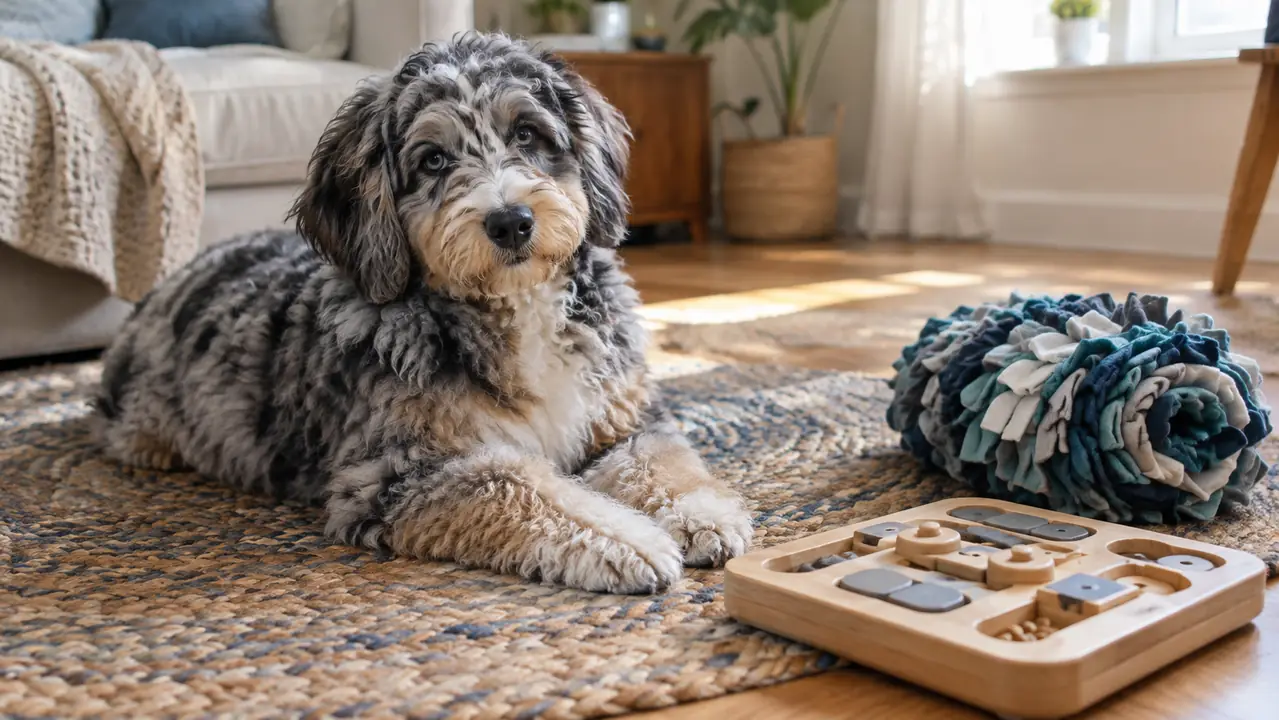
Some Saturdays, June needs more than a walk. She is a standard Aussiedoodle, which means she is about half genius and half goofball, and when the weather keeps us inside, she will find her own entertainment. Two autumns ago, that meant the corner of the living-room rug. So in September 2024 I bought the Outward Hound Nina Ottosson Dog Brick, a Level 2 treat puzzle, and I have also spent enough time at a friend's house watching their dog work a snuffle mat to have a real opinion on both. Here is the short version before the details: if you want your Aussiedoodle to think, get the Dog Brick. If you want your Aussiedoodle to settle, get a snuffle mat. Most of us eventually want both.
The short answer to the question in the title: the Outward Hound Dog Brick suits an Aussiedoodle better if you need a real thinking challenge that wears out a smart brain. A snuffle mat suits an Aussiedoodle better if you need something gentle and calming that is nearly impossible to get wrong. June works the Dog Brick most Saturdays while Dale and I watch college football, and it only comes out when one of us can sit with her. The snuffle mat belongs to a friend, and I have watched June nose through it a few times at their house. Neither toy replaces the other. This comparison should help you decide which one belongs in your house first, and which one you can add later.
My quick verdict: For a smart, busy Aussiedoodle, the Outward Hound Dog Brick is the better first buy. A snuffle mat is the better second buy.
Before the table, one honest note about my experience. I have owned the Outward Hound Dog Brick for about two years, so I can tell you exactly how it holds up and how a smart dog ages with it. I have only handled a snuffle mat at a friend's house, a few visits spread over the past year, so my opinion of the mat is shorter and partly borrowed. I will flag which is which as I go, because a comparison should not pretend both sides got equal time.
| Outward Hound Dog Brick | Snuffle mat | |
|---|---|---|
| The challenge | Level 2 puzzle with sliding blocks, flip lids and removable bone-shaped pieces. Treats stay hidden until your dog works for them. | Treats tuck into fleece strips. Your dog finds them by sniffing, no problem solving required. |
| Learning curve | June had the basic moves within the first week. You keep it interesting by changing where you hide the treats. | Nothing to learn. Sniffing and rooting come naturally to almost any dog. |
| Stays interesting | Only as hard as the hiding spots you invent. A smart dog solves the same layout faster each time. | It never gets solved. Every sniff is a fresh discovery, which is why it stays calming. |
| Cleanup | Wipe the tray and rinse the pieces. Crumbs stay mostly in one place. | Fleece strips trap crumbs and need a thorough dry between uses or they can get musty. |
| Toughness | Hard plastic, but supervised use only. It is a puzzle, not a chew toy. | Fabric can be chewed, dug at or shredded by a dog that would rather destroy than sniff. |
| Best for | A smart breed like an Aussiedoodle that needs real brain work on a rainy day. | A dog that settles best when it can sniff slowly, or a puppy that is not ready for a puzzle. |
The table is the short version, but it deserves one more sentence in plain English. The Dog Brick is the toy I reach for when June needs to work for her treats and think her way through something. The snuffle mat is the toy I would reach for when a dog needs to slow down and just sniff. If your Aussiedoodle is smart and bouncy like June, start with the Brick.
How I've Used the Dog Brick
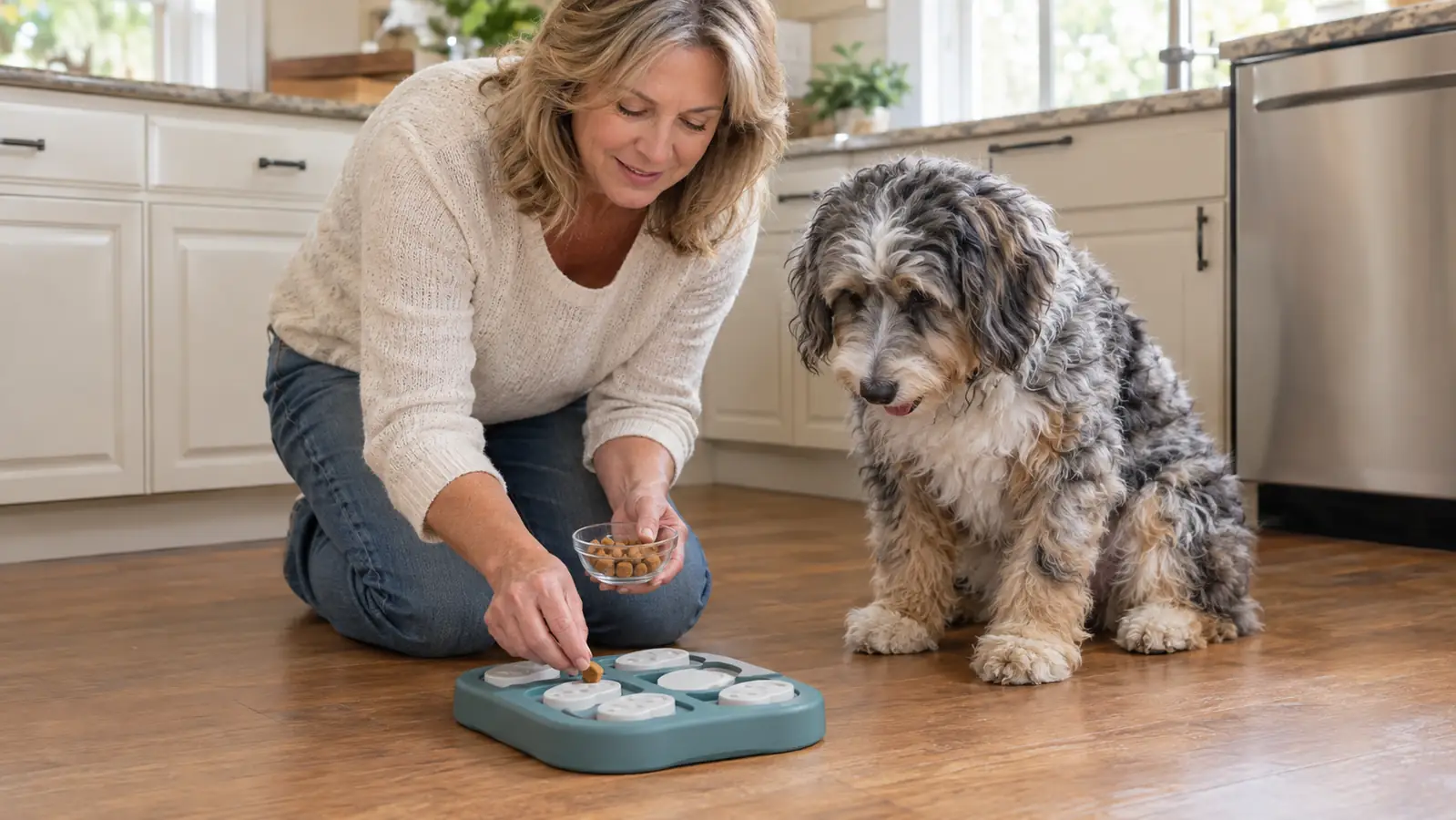
The Dog Brick came home in September 2024, when June was about a year old and full of opinions. She is a standard Aussiedoodle, 48 pounds of blue merle with a wavy-curly coat, and she learns things faster than I do. Within the first week she had the basic moves down: the sliding blocks, the flip lids, the little bone-shaped pieces that lift out to hide a treat underneath. That could have been the end of it, but the puzzle is only as hard as the hiding spots you invent, so I started tucking treats in different corners each Saturday. Some weeks she checks every compartment twice. Some weeks she goes straight to the spot where I hid them last time, finds nothing, and then actually thinks about where I might have put them instead.
The other thing I notice is how she approaches it. She does not dive in nose-first like she does with a bowl of food. She sits, watches the tray, and uses a paw to slide a block, then waits to see if a treat appears. It is the closest thing to patience I have ever seen from her, and for a dog that usually operates at full speed, a few minutes of deliberate thinking is worth more than any walk.
The other thing I can tell you after two years is that it holds up. The tray is hard plastic, the pieces rinse under the tap, and a crumb of training treat wipes off in seconds. It is not a chew toy, so I only bring it out when one of us can sit with June, and it goes back on the high shelf in the hall closet when she is done. Rainy days and football Saturdays, that is the routine. Two years in, the Brick looks the same as the day it arrived, which is more than I can say for the stuffed toys June has eviscerated in about fifteen minutes each.
Where the Dog Brick Wins
The Dog Brick wins on the thing a treat puzzle is supposed to do: it makes a smart dog think. An Aussiedoodle without a job will invent one, and June's inventions used to involve the corner of the rug. On those first football Saturdays she spent about ten minutes working through every compartment, checking each hiding spot twice, and that kind of focused problem solving is exactly what a smart, bouncy, curly dog needs on a day when a walk is not happening. It is the difference between a dog that is quietly occupied and a dog that is actually tired afterward.
It also wins on cleanup and toughness, and those matter more than they sound like they do. Hard plastic wipes clean in seconds, and the pieces rinse under the tap. A snuffle mat collects crumbs deep in its fleece strips and needs to dry fully between uses, or the fabric starts to smell. And while the Dog Brick is not a chew toy, hard plastic holds up far better than fabric in a house with a dog who has opinions about things. I still supervise every session, and the Brick lives on the shelf between uses, but two years in it looks the same as the day it arrived.
Two years in, the Outward Hound Dog Brick still looks the same as the day it arrived. I cannot say that about much else June owns.
Where a Snuffle Mat Wins
The snuffle mat wins on simplicity, and simplicity is a real feature, not a consolation prize. There is no learning curve, no level system, no sequence of moves. You scatter a few treats into the fleece, your dog sniffs, roots and grazes, and when she is done she is calmer. Watching June work my friend's mat, I noticed she never looked frustrated, because there is nothing to figure out. Sniffing is the whole game, and a dog cannot fail at it. For a puppy, a senior dog, or a dog that gets annoyed when a puzzle does not give up its treats fast enough, that matters a lot.
It also wins on two smaller things. A snuffle mat rolls up flat, so it disappears into a drawer, while the Dog Brick is a rigid tray that needs shelf space. And a snuffle mat never gets solved. The Dog Brick is only as hard as the hiding spots I invent, and June knows the basic moves now, so a routine layout takes her just a few minutes. The snuffle mat has no moves to learn, which means it stays exactly as engaging on the hundredth use as it was on the first. That makes it the better choice for a dog who needs to decompress instead of compete.
A smart Aussiedoodle needs the harder job
If June is anything like your dog, a puzzle that makes her think will earn its keep faster than a mat that lets her graze. The Outward Hound Nina Ottosson Dog Brick has held up through two years of football Saturdays, and it is still the toy she heads for first.
Amazon Check Today's Price on Amazon →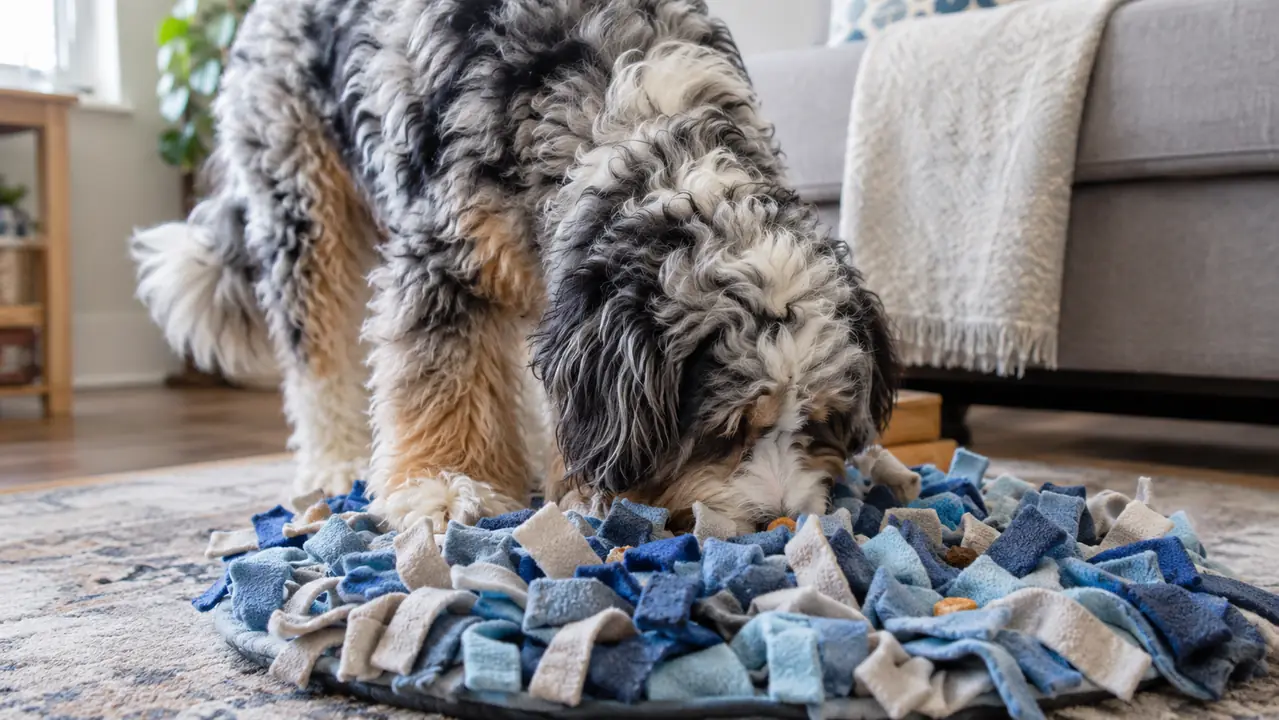
The Honest Tradeoff
Here is the tradeoff nobody likes to say out loud. A snuffle mat is easier, but easier is not always better for a dog like June. She is three years old, 48 pounds, and smart in a way that gets her into trouble when she is bored. Left to herself, she will find the thing I forgot to put away and turn it into a project. She needs the harder job, and the Dog Brick gives her one. A snuffle mat would calm her, sure, but it would not challenge her, and a bored Aussiedoodle does not need more calm. She needs to think.
That said, I would not call the snuffle mat a waste of money, because it is not. If June were a puppy again, or if she were ten years old with stiff hips, I would reach for a mat first. It asks nothing of the dog except to be a dog, and there are seasons of life where that is exactly the right ask. The mistake is treating them as the same toy. They are not. One is a workout for the brain and the other is a nap for it, and a dog like June needs both, just at different times.
Who Should Buy Which
Buy the Outward Hound Dog Brick if your Aussiedoodle is anything like June: smart enough to learn the moves in a week, restless when the weather cancels a walk, and happy to sit and work a puzzle for a few focused minutes while you watch the game. It suits a dog that needs a job, and it suits an owner who will supervise, because this is a puzzle, not a chew toy. It is also the better choice if you want a toy that wipes clean and will still be around in two years.
Buy a snuffle mat if your dog is young, old, or easily frustrated. A puppy that is still learning to settle, a senior whose joints do not love the floor, or a dog that would rather shred fleece than solve a puzzle all do better with the gentle sniffing game. If your dog's idea of a good time is slow and calm, the mat is the one that will actually get used, because it asks nothing of the dog except to be a dog.
If I had to pick one for June, I would pick the Dog Brick, because she is a thinker and she needs the harder job. But I keep a mental note that a snuffle mat would be the easier pick for a younger or less puzzle-minded dog. They are different tools for different moods, and a house with an Aussiedoodle usually needs both eventually. Start with the puzzle that makes them think. Add the mat when you need calm.
One last thing, and it applies to both. Stay in the room. The Dog Brick is not a chew toy, and a snuffle mat is fabric that a determined dog can pull apart. Both are tools for supervised time, not babysitters. Use them that way and they will last, and so will your couch.
Start with the puzzle that makes them think
The Outward Hound Nina Ottosson Dog Brick is the Level 2 challenge that has survived two years with a 48-pound Aussiedoodle. Supervise the session, change the hiding spots, and put it away when you are done.
Amazon Check Today's Price on Amazon →