
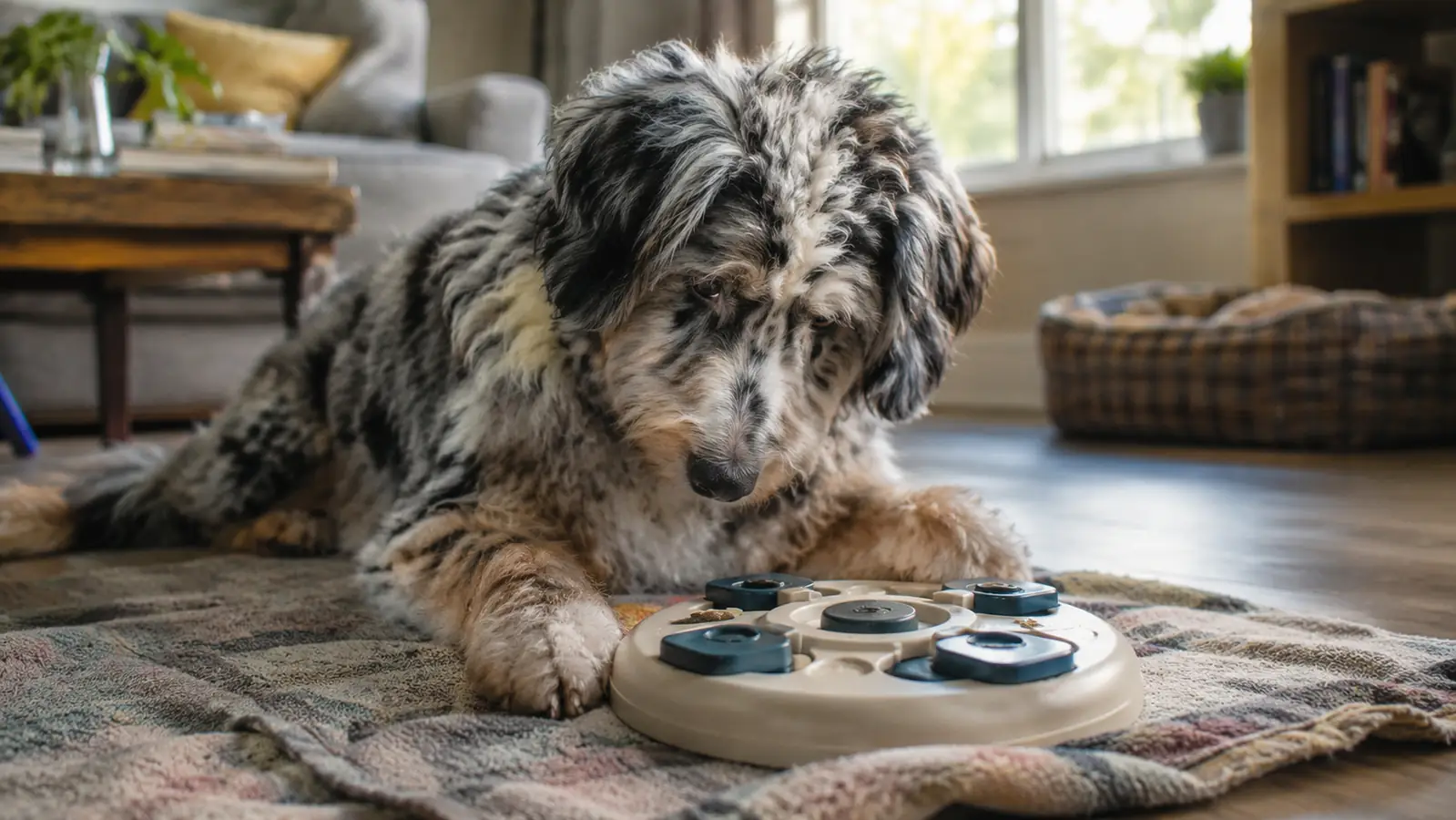
If you live with an Aussiedoodle, you already know the look. The one where she is parked at your feet, chin on your knee, eyes locked on you, and you can almost hear her thinking, "Now what?" June gives me that look on rainy afternoons and on Saturdays when the game is on and she has already had her walk. A smart, bouncy dog like an Aussiedoodle does not just need exercise. She needs something to do with her brain. That is where the Outward Hound Nina Ottosson Dog Brick comes in.
I am Carla, and I have a three-year-old standard Aussiedoodle named June. She is about 48 pounds, blue merle, with a wavy-curly coat that keeps me busy with a slicker brush most evenings. I am not a trainer or a vet, just a dog owner who found a tool that actually helps on the days when June has more energy than the weather will let us burn off. This is how I use the Outward Hound Dog Brick to beat Aussiedoodle boredom, step by step.
Give your smart Aussiedoodle a job to do
The Outward Hound Nina Ottosson Dog Brick is the Level 2 treat puzzle I reach for on rainy days and football Saturdays. It hides treats behind sliding blocks, flip lids, and removable bone-shaped pieces, and it gives a clever dog something to figure out.
Amazon Check Today's Price on Amazon →Step 1: Pick the right puzzle for your dog's level
The Outward Hound Nina Ottosson line has different levels for a reason. Level 1 puzzles are mostly sliding doors and simple compartments. Level 2 puzzles, like the Dog Brick, add flip lids and removable pieces that ask a dog to think a little harder. Level 3 puzzles stack more challenges on top of that. If your Aussiedoodle is new to treat puzzles, starting at Level 2 is usually fine because these dogs pick up the idea fast. June solved the basic moves within her first week, and by the second week she was sliding the blocks before I had even finished loading the last well.
The Dog Brick has sliding blocks that cover treat wells, flip lids that hinge open, and bone-shaped pieces that lift out of their slots. That mix is what makes it interesting. A dog cannot just nose the same lid over and over. She has to slide, flip, and lift, and she has to remember which spots she already cleared. For a breed that gets bored when the routine is too easy, that variety is the whole point. I filled every spot the first time I loaded it, and I remember thinking that was plenty for a dog who had never worked a puzzle before.
One thing I will tell you straight: this is a treat puzzle, not a chew toy. I only bring it out when I can watch June work on it, and I put it away when she is done. The pieces are meant to be moved by a nose and a paw, not gnawed on by a determined dog. Supervised use keeps it fun and keeps the pieces intact. I learned that rule the easy way, by reading the instructions, not the hard way, and I have never had a piece so much as cracked.
Step 2: Choose treats that are worth the work
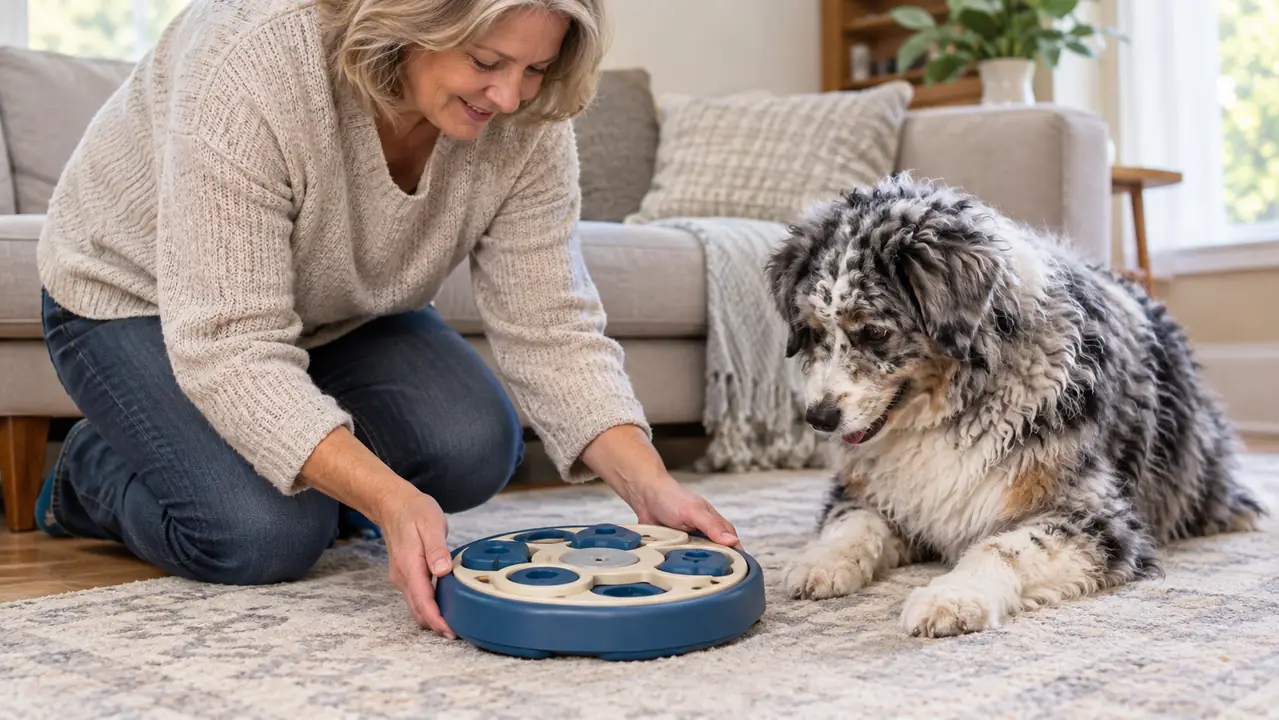
The treats you hide matter more than you might think. If the reward is not worth the effort, a smart dog will figure that out in about thirty seconds and walk away. I use small, soft treats that June can smell easily but that do not crumble into dust inside the puzzle. Tiny training treats work well. So do little pieces of her regular kibble on days when I want to keep her treat intake low. I tried a hard biscuit once, and she spent more time licking the crumbs out of the seams than actually working the pieces.
I also mix up where I hide them. Some days I slide the blocks over the wells and leave the flip lids empty. Other days I tuck a treat under every bone-shaped piece and leave a couple of blocks open. The variation is what keeps June guessing. If she always found a treat in the same spot, the puzzle would stop being a puzzle and start being a bowl. On the Saturdays when Dale and I watch football, I usually load the bones and the flip lids and leave the sliding blocks for last, because that is the order June seems to enjoy most.
A note on quantity: I keep the total treats small. The goal is a few minutes of focused brain work, not a snack buffet. About ten small pieces is plenty for June. She gets the satisfaction of finding every one, and I get a dog who is ready to flop down and nap instead of pacing the living room. On days when she has already had a lot of training treats, I use plain kibble and she does not seem to mind one bit.
Step 3: Set up the puzzle in a calm, quiet spot
Where you put the puzzle matters. I learned this the first time I tried to give June the Dog Brick in the middle of the kitchen while Dale was making coffee and the radio was on. She could not focus. Her head was on a swivel, and the puzzle sat untouched for a full minute before she even looked at it. I sat there thinking I had wasted the money, and then I moved us to the living room and everything changed. Now I set it up on the living room floor, on an old towel, with the TV off or the game on mute.
The towel is not just for looks. Treat crumbs and a little drool end up on the floor, and the towel catches most of it. It also gives June a clear signal that this is puzzle time, the same way her bed tells her it is nap time. Dogs are creatures of routine, and a consistent setup helps them settle into the activity faster. The towel is the same one she lies on for brushing, so she already associates it with calm, focused time.
I also make sure June has had a chance to go outside first. A dog who needs to pee is not going to care about a puzzle. A short walk or even five minutes in the backyard takes the edge off, and then she is ready to focus. The puzzle works best as a calm activity, not a way to manage a dog who is already bouncing off the walls. On rainy mornings I will do a quick fetch session in the hallway first, just enough to take the wild edge off, and then bring out the Brick.
Step 4: Let your dog work it out, then step in only when needed
The hardest part of using a treat puzzle is keeping your hands off it. I know. When June first tried the Dog Brick, she nudged a sliding block the wrong way, looked at me, and I had to stop myself from sliding it for her. The whole point is for her to figure it out. If I solve it for her, she learns that waiting for me is easier than thinking. I sat on the floor beside her for the first few sessions, and I can tell you my knees were not happy about it, but it was worth it.
I sit nearby and let her work. If she gets stuck on one piece for a while, I might tap the piece or point at it, but I do not move it for her. Most of the time she figures it out on her own within a few seconds. Aussiedoodles are problem solvers. Give them the space to solve, and they will surprise you with how quickly they learn. The first time she flipped a lid, she looked up at me with her ears up, and I could tell she was proud of herself.
The first time June used the Dog Brick, she spent about ten minutes on it. Now she moves through it in a few minutes, so I keep it interesting by changing where I hide the treats. Some days I put them all under the flip lids. Some days I leave a bone-shaped piece sitting loose on top with a treat underneath. The puzzle stays the same, but the game changes. I have also started loading it in front of her so she can watch where the treats go, which makes the whole thing feel like a game of hide and seek.
Step 5: Put it away when she is done
When June has cleared every treat, I pick the puzzle up and put it on a high shelf in the hall closet. It does not stay on the floor. There are two reasons for this. First, the Dog Brick is not a chew toy, and leaving it out invites a bored dog to test that rule. Second, if the puzzle is always available, it stops being special. Part of what makes it work is that it only comes out on certain days. The shelf is high enough that June cannot reach it even when she stands on her back legs, and that is exactly where it belongs.
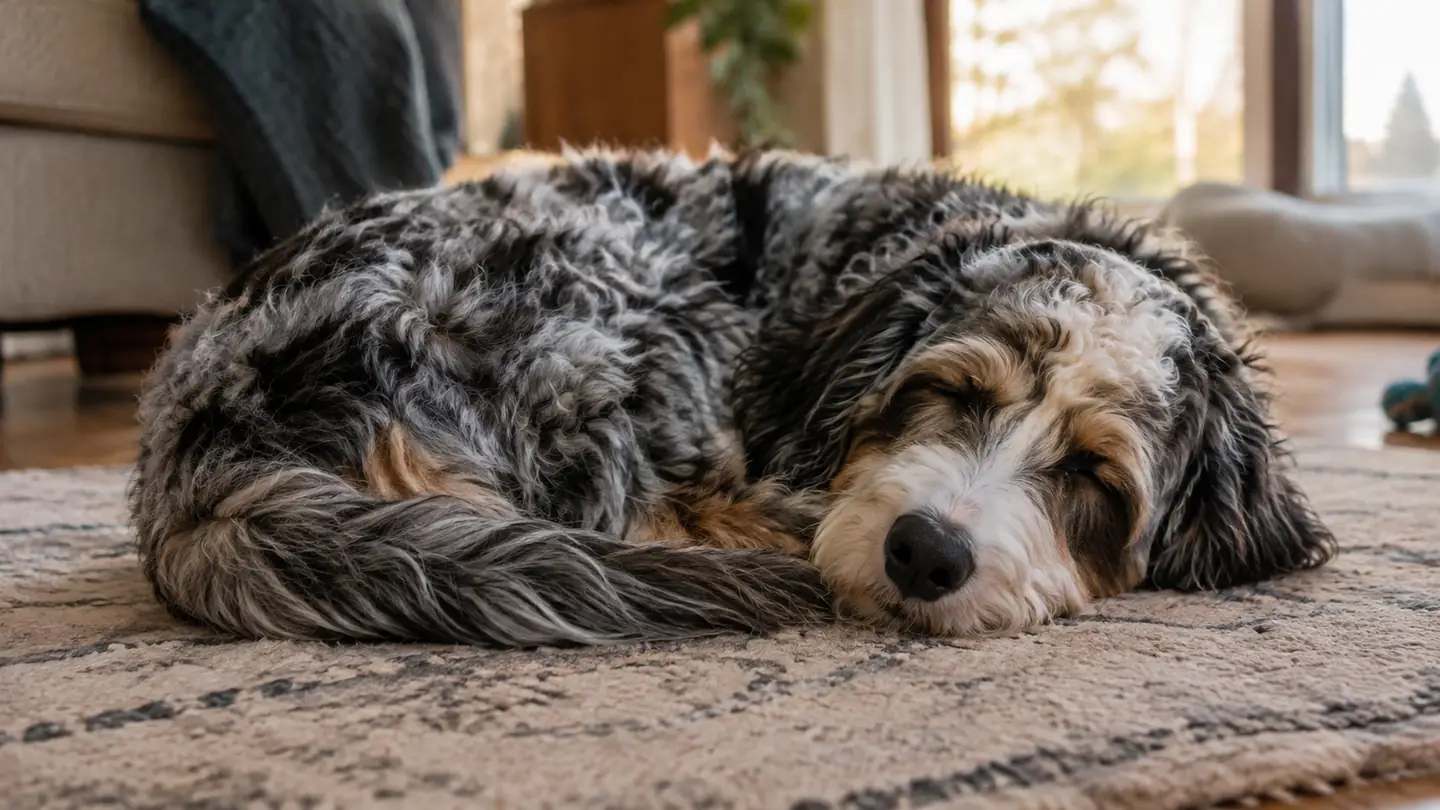
For us, that means rainy days and college football Saturdays. Dale and I watch the game, and June gets her puzzle on the living room floor beside us. She works through it, licks the last crumb out of the last well, and then usually curls up on her orthopedic bed by the front window and naps through the second half. That is the outcome I am after: a tired, satisfied dog who is not looking for something to chew. Last Saturday she finished the puzzle by the first commercial break and was asleep before the second quarter ended.
Cleaning is easy, too. The Dog Brick is hard plastic, and I wipe it down with a damp cloth after each use. I do not put it in the dishwasher. A quick wipe, a dry shelf, and it is ready for the next rainy Saturday. I also check the pieces once in a while for any rough edges, and so far, after two years of use, everything still fits together the way it did the day it arrived.
What Else Helps
The Outward Hound Dog Brick is one piece of the puzzle, no pun intended. June still needs her morning walk, her backyard fetch sessions, and the brushing routine that keeps her wavy coat from matting. The treat puzzle is not a replacement for exercise. It is an addition, and it is a good one for the days when the weather or the schedule keeps you inside. I bought the Brick in September 2024, and it has been part of our routine ever since.
If your Aussiedoodle is anything like June, you already know that a tired dog is a happy dog. The Dog Brick gives her a way to burn mental energy, and mental energy counts. A dog who has spent ten minutes figuring out where the treats are hidden is a dog who is ready to settle down. Pair it with a walk, a good brushing session, and a comfortable place to nap, and you have a much calmer household. That is the routine that works for us, and it is the one I would recommend to any owner of a smart, bouncy Aussiedoodle.
A dog who has spent ten minutes figuring out where the treats are hidden is a dog who is ready to settle down.
Rainy day? Give your Aussiedoodle something to think about
The Outward Hound Nina Ottosson Dog Brick turns a bored, restless dog into a focused one. It is the treat puzzle I trust on days when June has more energy than the weather will let us burn off.
Amazon Check Today's Price on Amazon →