
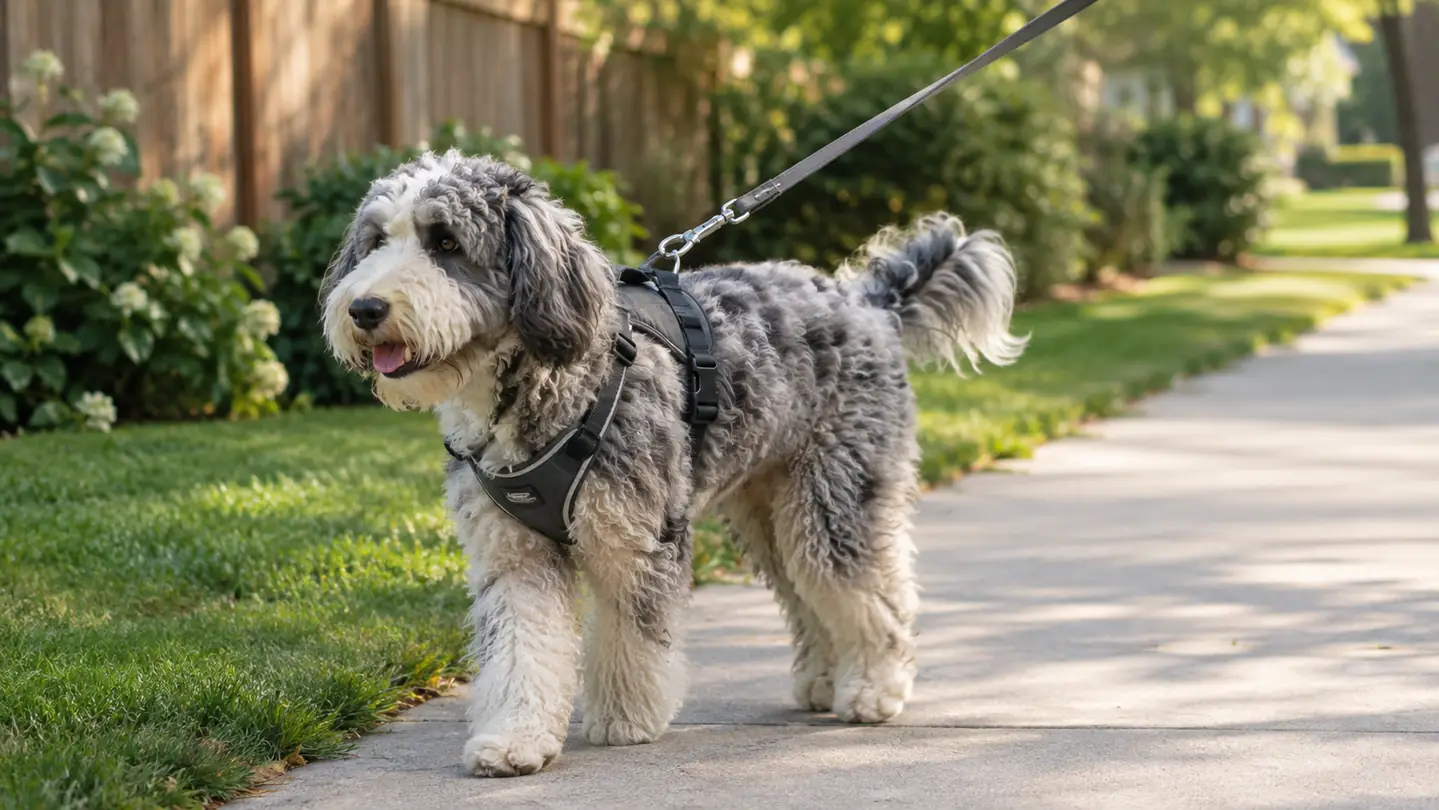
June was about seven months old when I admitted the flat collar was not going to work. She is a standard Aussiedoodle, blue merle with a wavy-curly coat, 48 pounds of bounce and curls today and a little over thirty back then, and in the spring of 2024 she pulled on the leash like she was late for something important. I am Carla, and I walk June about 45 minutes most mornings before my shift at the dental office. The pulling got bad enough that my shoulder started complaining, so I went looking for a no pull harness. I bought the rabbitgoo No Pull Harness in March 2024, and it has been on June for nearly every walk since. This comparison is about how that harness has held up for two and a half years of real dog life, and how it stacks up against the PetSafe Easy Walk, which I have only handled briefly, at a friend's house and once at a pet store.
Here is the short answer. If you want one harness that does daily walks, weekend trail hikes and the occasional strong pull, the rabbitgoo wins because it gives you a front clip and a back clip on the same padded, adjustable vest. The PetSafe Easy Walk is a lighter, front-clip-only design with a martingale loop over the shoulders, and it is the stronger steering tool of the two. I would send a determined puller to the Easy Walk for short training walks. I would send almost everyone else to the rabbitgoo for everyday life. And I would remind you, the way I remind myself, that neither harness does the training for you. I am not a trainer, and the harness was a tool, not the answer.
How I've Used Both
I can give you a long-term opinion on exactly one of these harnesses, so let me be clear about which one that is. The rabbitgoo has been on June since March 2024, about two and a half years now, and it replaced a flat nylon collar we were walking her on. For the first several months I used the front clip almost every single walk, because June's pulling was worst from about five to twelve months old. The front clip turns her toward me when she pulls, and it gave me enough control that we could actually practice walking nicely instead of just holding on. By the time June hit her first birthday, the walks had calmed down. I still use the front clip on our neighborhood walks and switch to the back clip for weekend trail walks with my husband Dale.
The PetSafe Easy Walk is a different story, and I want to be honest about the limits of what I am comparing. I have not owned one. I have handled one at a friend's house and tried one on June at a pet store, so I know how it goes on, where the clip sits and how the martingale loop feels across the shoulders. What I cannot tell you is what the Easy Walk is like at month eight, because I have not lived with it. I would rather tell you that plainly than pretend this is a long-term shootout between two harnesses I own. What I can do is walk you through how the two designs differ, what I noticed in the time I spent with each, and which kind of dog I would point toward which harness.
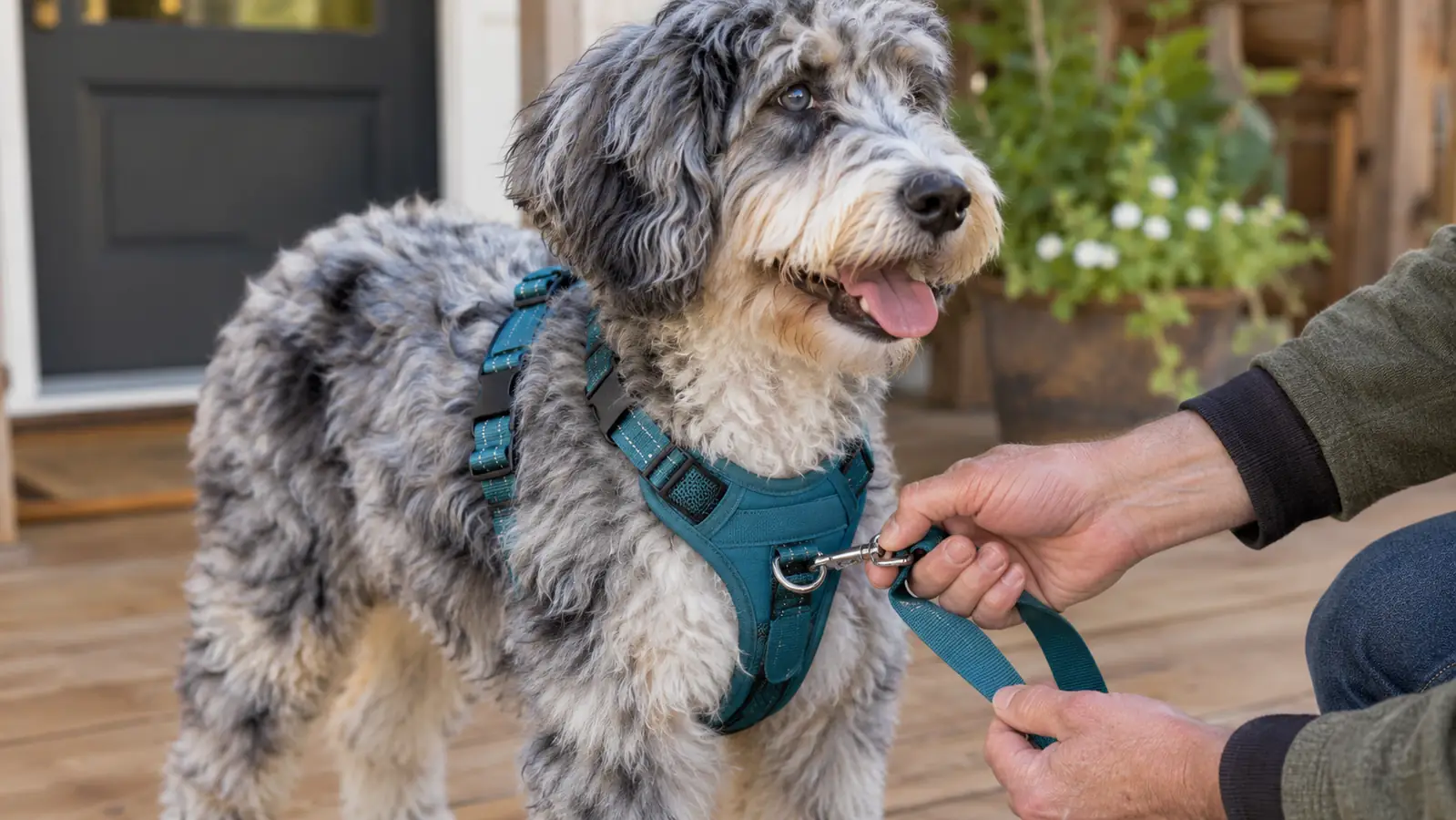
The Big Differences at a Glance
| rabbitgoo No Pull Harness | PetSafe Easy Walk | |
|---|---|---|
| Price | Budget-friendly for a padded two-clip harness; check today's price | Budget-friendly and widely available; check today's price |
| Leash clips | Front clip and back clip on the same harness, so you can switch by mood, trail or training stage | Front clip only, one attachment point by design |
| Steering on a pull | Front clip turns the dog toward you; steering is gentle because the padded panels spread the pull | Front clip at the chest with a martingale loop; the strongest steering of the two |
| Padding | Padded vest-style panels spread pressure across the chest and belly | Thin straps with minimal padding, which keeps it light |
| Getting it on | Padded vest that slips over the head and buckles, with adjustable straps | Slips over the head, then two belly straps to adjust |
| Reflective strips | Reflective strips for early morning and evening walks | I did not see reflective trim on the one I handled |
| Curly coat care | Padded panels cover more coat, so brush the armpits and chest after walks | Thinner straps sit against a narrower line; same strap-line rule applies |
| Best for | Everyday neighborhood walks, weekend trails, strong pullers that still need padding | Short training walks where maximum steering is the main goal |
The One Thing Both Harnesses Have in Common
Here is the thing nobody warned me about when I bought a harness for a curly-coated dog. Any strap that sits against the coat for 45 minutes will eventually rub curls into tangles, and the harness strap line is exactly where that happens. With June it shows up behind her front legs and across her chest, right along the strap line. After every walk I run my fingers over those spots, and a few evenings a week I brush them with the slicker and a little detangler spray before I do her main brushing. That routine is not about the brand of harness. It is about owning a dog whose coat mats behind the ears, in the armpits and along the collar line if you ignore it.
Both of these harnesses sit against the coat at the chest, so I would not tell you that either one will never tangle a curly coat. The rabbitgoo spreads that contact across padded panels, which I think makes the rubbing gentler, and the Easy Walk's thinner straps press into a narrower line. But the honest answer is that any harness needs the same care on a dog like June. If your groomer ever mentions friction along the chest, a padded harness is worth trying, and brushing the strap line after walks is worth doing no matter which one you buy. Ask your groomer about your dog's coat specifically, because every curly coat is a little different.
Where rabbitgoo Wins
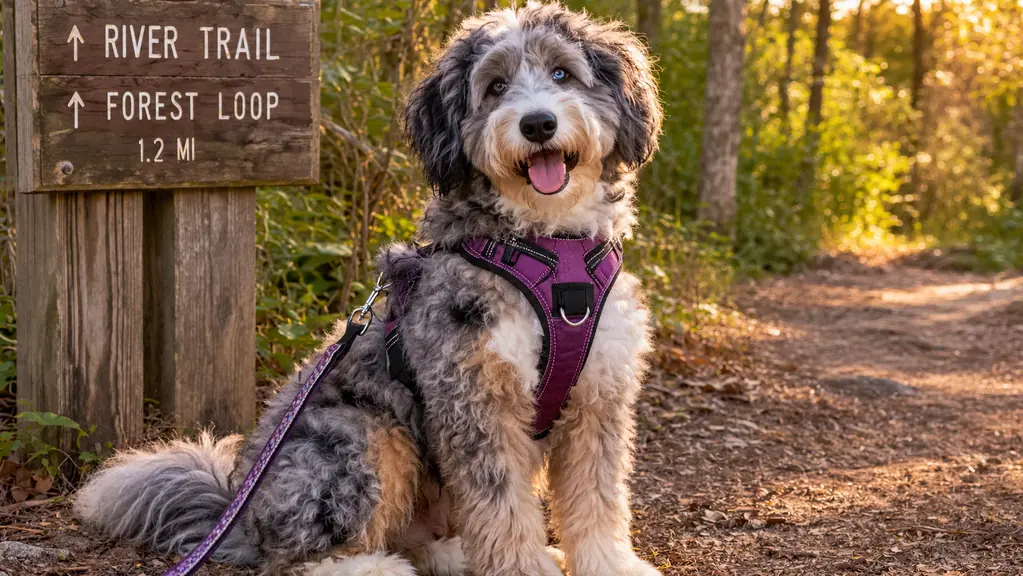
Having two clips is the rabbitgoo's biggest advantage for us. On our neighborhood walks the leash goes on the front clip, because one squirrel is all it takes for June to remember her old habits, and the front clip turns her back toward me the moment she pulls. On weekend trail walks with Dale, where she has room to roam, the leash goes on the back clip, which is relaxed and comfortable for a dog who is mostly walking nicely. Having both options on one harness means one harness covers every kind of walk we take, and I never have to swap gear before heading out.
The padding matters for a curly-coated dog, and so do the reflective strips. June is 48 pounds of bounce, and when she does pull, the pressure spreads across the padded chest panels instead of cutting into a single strap line. The reflective strips are a small thing that became a big thing once I started walking her before dawn in the fall, because cars on our road can see her coming. I also like that the adjustable straps let me get the fit right once and leave it, so putting it on June by the front door takes a few seconds. None of this is magic, and it does not stop pulling by itself. It just makes everyday walking easier, and after two and a half years, the stitching and clips still hold.
Where PetSafe Wins
I will give the Easy Walk its due, because a fair comparison has to. Its front clip sits at the chest with a martingale loop over the shoulders, and in the brief time I spent with one, the steering was the strongest I have felt in any harness. When the leash attaches at the chest and the loop gently tightens across the shoulders as the dog pulls, the dog is turned back toward you with very little effort from your end. For a dog still in the hard-pulling stage, the kind of pulling June did at six months old, that is a real advantage, and I would not pretend otherwise. If your goal is maximum steering on a short training walk, the Easy Walk is the stronger tool.
The Easy Walk is also lighter and simpler, and that is worth something. There is less harness on the dog, which some dogs prefer, especially in warm weather, and some owners prefer the clean look of thin straps over a padded vest. I tried one on June at the pet store and it fit her fine, and the front clip sat in the right spot on her chest. For a dog that walks well most of the time and only needs the front clip as a reminder, the lighter harness does the job with less bulk. I have not owned one long enough to tell you how the straps hold up at month eight, so I will not pretend to have that opinion, but as a steering tool, it earns its reputation.
Two clips, one harness, and two and a half years of June
The rabbitgoo No Pull Harness is the one I reach for every morning. Front clip for neighborhood walks, back clip for the trail, padded panels for a curly coat, and reflective strips for early walks. Check today's price on Amazon and see the size options for your dog.
Amazon Check Today's Price on Amazon →Who Should Buy Which
Buy the rabbitgoo if you want one harness for real life. If your dog pulls hard on neighborhood walks but also needs to be comfortable for a two-hour trail hike, the two clips and the padding make it the better everyday choice. It is also the better choice if your dog has a thick or curly coat and you want pressure spread across padded panels instead of thin straps, or if you walk before dawn and want reflective strips. That is my life with June, and it has been my harness since March 2024. For a smart, bouncy Aussiedoodle who is still learning leash manners, the front clip gives you control while the back clip gives you a normal walk later.
Buy the PetSafe Easy Walk if maximum steering is your main goal and you are willing to treat it as a training tool on shorter walks. If your dog is in the stage June was in at six months old, and you want the strongest front-clip steering you can get, the Easy Walk's martingale design does that job very well. It is lighter, simpler and easier to ignore once it is on. Just know that neither harness trains the dog by itself. I am not a trainer, and the thing that actually fixed June's pulling was consistency: front clip every walk, stop and wait when she pulled, praise when the leash went slack. The harness was a tool in that routine, not the whole answer, and no piece of gear replaces the repetition. Both of these harnesses carry strong star ratings on Amazon, and both are popular for a reason.
The Bottom Line
So here is where I land after two and a half years. The rabbitgoo is the harness I would buy again for June, because it covers every walk we take, from 45 minutes around the neighborhood to a full trail afternoon with Dale. The PetSafe Easy Walk is a good harness and the stronger steering tool of the two, and if your dog is in the hard-pulling stage, it deserves a close look. But for a smart, bouncy, curly-coated Aussiedoodle living a normal dog life, the rabbitgoo's two clips, padded panels and reflective strips win the everyday battle. If anything about your dog's shoulders or chest looks wrong, ask your vet, and if the coat is rubbing, ask your groomer. That is what I do, and it has kept June comfortable for two and a half years.
The harness I put on June every single morning
If your Aussiedoodle pulls on the leash and you want front-clip steering plus a back clip for relaxed trail walks, the rabbitgoo No Pull Harness is the one I have used for two and a half years. Check today's price on Amazon and find your dog's size.
Amazon Check Today's Price on Amazon →