
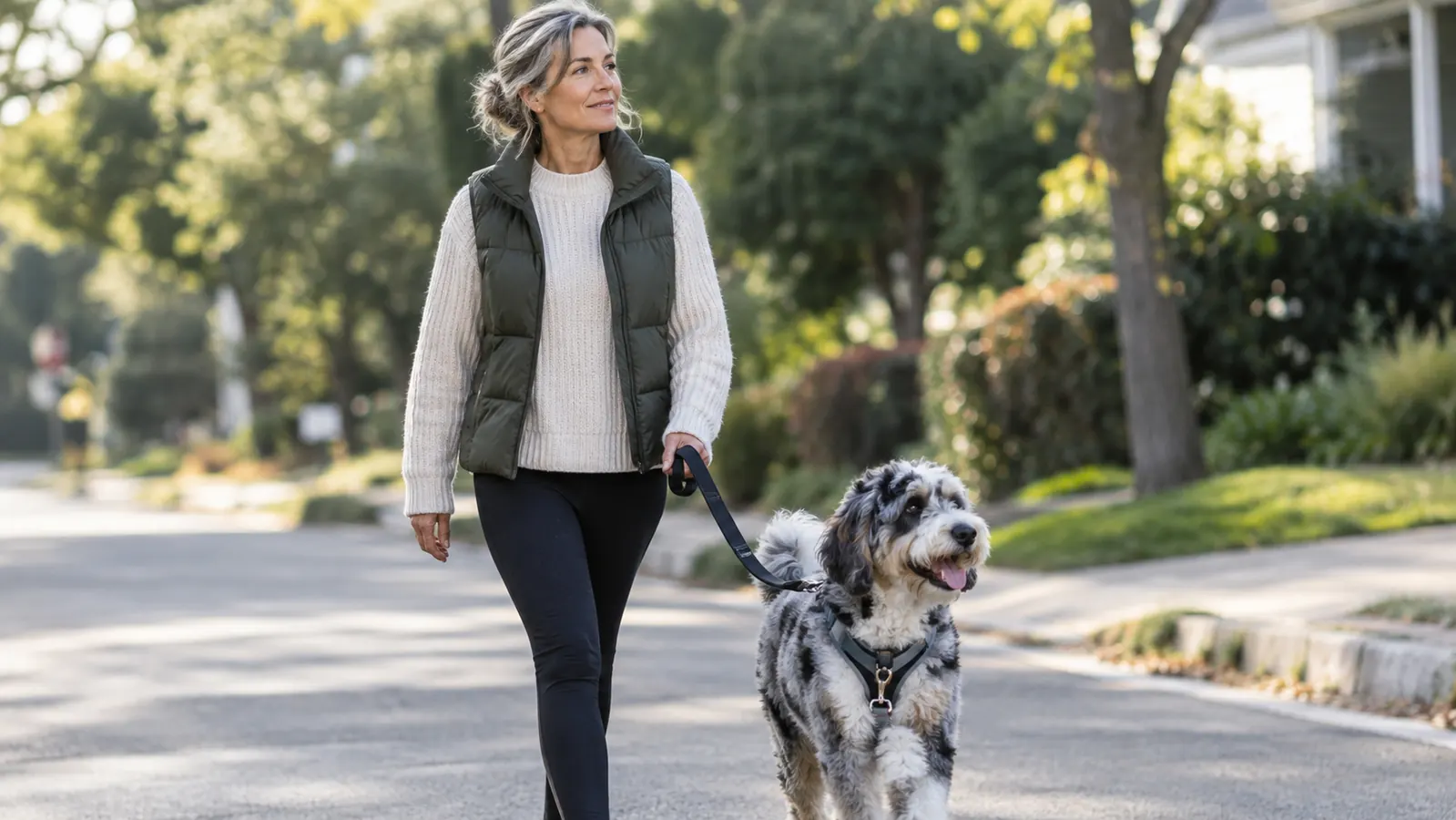
If you have an Aussiedoodle who turns every walk into a tug of war, I have been exactly where you are. My girl June is a standard Aussiedoodle, about 48 pounds of bounce and brains, and from about five months old to a year old she pulled on the leash like her job depended on it. I tried a flat collar first, and it did nothing except make me worry about her neck. What finally turned our walks around was a front-clip harness, specifically the rabbitgoo no pull harness, plus a few small changes in how I started each walk. This is the exact routine we used, step by step.
I am not a trainer. I am a dental hygienist who loves her dog and got tired of being dragged down the sidewalk. Everything here is what worked for us, and I will tell you plainly what the harness can and cannot do. It is a tool, not a magic fix. The tool plus a consistent routine is what made the difference.
Start every walk with a harness that turns pulling into a gentle turn
The rabbitgoo no pull harness has a front clip that redirects your dog toward you the moment they pull, plus a back clip for relaxed weekend trail walks. It is the harness that made our morning walks calm again.
Amazon Check Today's Price on Amazon →Step 1: Fit the harness properly before you ever leave the house
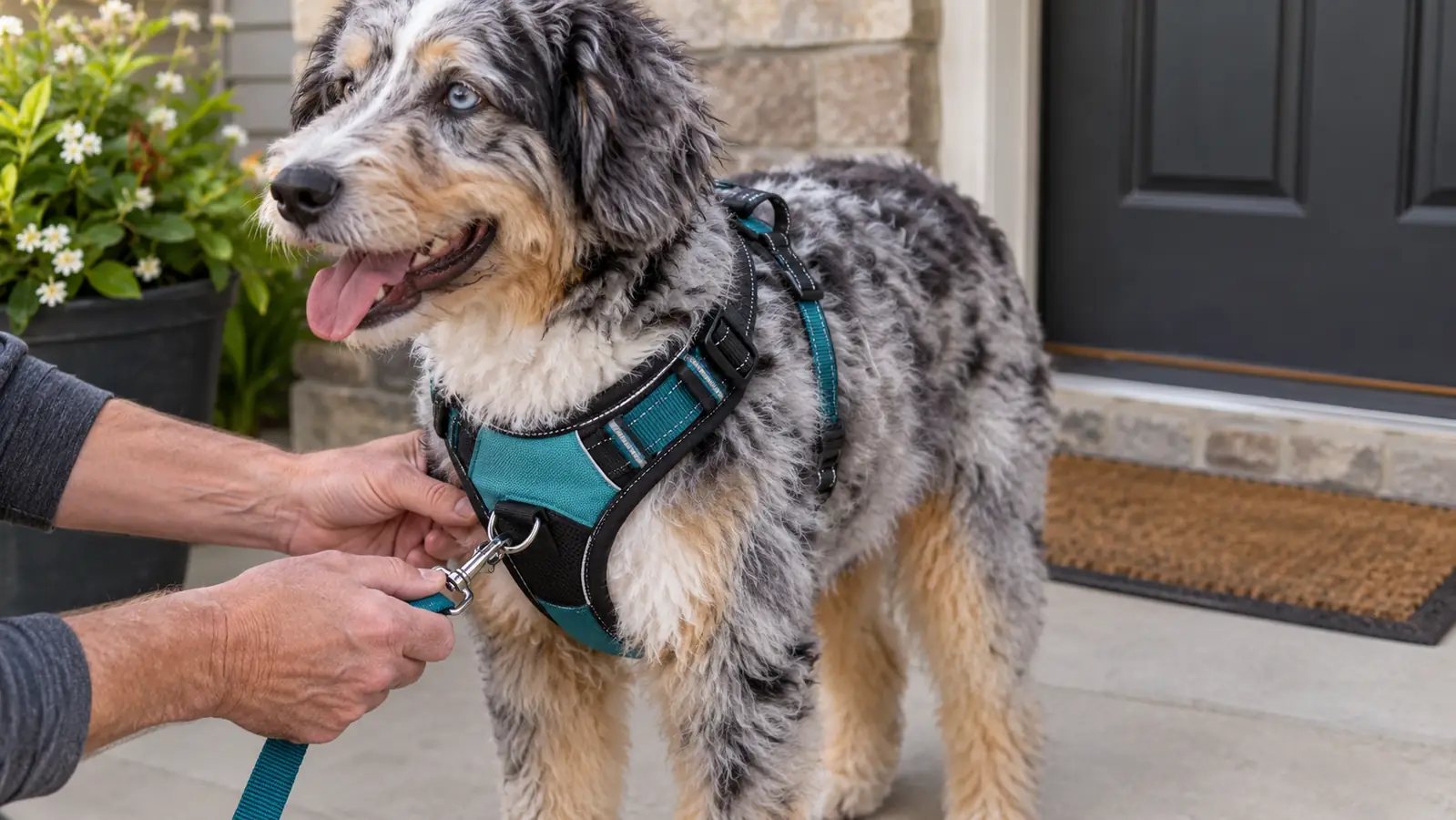
A harness only helps if it fits, and most pulling problems get worse when the harness shifts or rubs. The rabbitgoo harness is a padded vest style with adjustable straps, so it can be dialed in to a deep-chested, curly dog like an Aussiedoodle. I bought the size L for June in March 2024, when she was about seven months old and still growing into her adult frame. The first time I put it on her, I had the straps too loose and the whole thing slid sideways before we reached the end of the driveway. I took her back inside, tightened the chest strap, and tried again.
The fit check I still use: you should be able to slide two fingers flat under the straps at the chest and behind the front legs, but the harness should not be loose enough to twist. If it twists, the front clip ends up in the wrong place and the whole point is lost. I also check the strap line under her armpits after every walk, because that is exactly where a harness can rub curls into tangles on a wavy-coated dog. On June, that spot sits right where her wavy-curly coat is thinnest, so a rubbing strap shows up fast.
One more thing: put the harness on when the dog is calm, not when they are already bouncing at the door. I started asking June to sit before I clipped it on. That small pause set the tone for the whole walk. It took about a week before she stopped spinning in circles at the sight of the harness, and now she stands still and waits for the click of both clips.
Step 2: Use the front clip for everyday neighborhood walks
The rabbitgoo harness has two leash clips, and they do different jobs. The front clip, on the chest, is the one that changes pulling. When June pulled ahead, the leash attached at her chest turned her gently back toward me. She did not get choked or corrected, she just found herself facing me instead of the squirrel. That redirection is what taught her that pulling did not get her where she wanted to go.
I used the front clip for our regular morning walks, about 45 minutes most days before my shift. The first couple of weeks were not magical. She still tried to lunge after things, and the harness turned her around, and we repeated that a hundred times. One morning in April 2024 she spotted a cat across the street and hit the end of the leash so hard that the front clip spun her a full half circle to face me. She looked almost confused, then trotted back to my side. That was the moment I knew the mechanics were working. But by the time she was about a year old, the pulling had mostly stopped. The harness did not train her by itself. The repetition did. The harness just made the repetition safe and clear.
Keep the leash short enough to feel connected but loose enough that there is no constant tension. If you keep tension on the front clip the whole walk, the dog never learns what a slack leash feels like. I aimed for a soft J shape in the leash, and I let June sniff when she was not pulling. Sniffing is her job on a walk, and a dog who gets to sniff is a dog who is less desperate to pull toward the next smell. I also learned to change direction without warning every so often, so she had to keep an eye on where I was going instead of just dragging me toward whatever she wanted.
Step 3: Switch to the back clip for trail walks and decompression
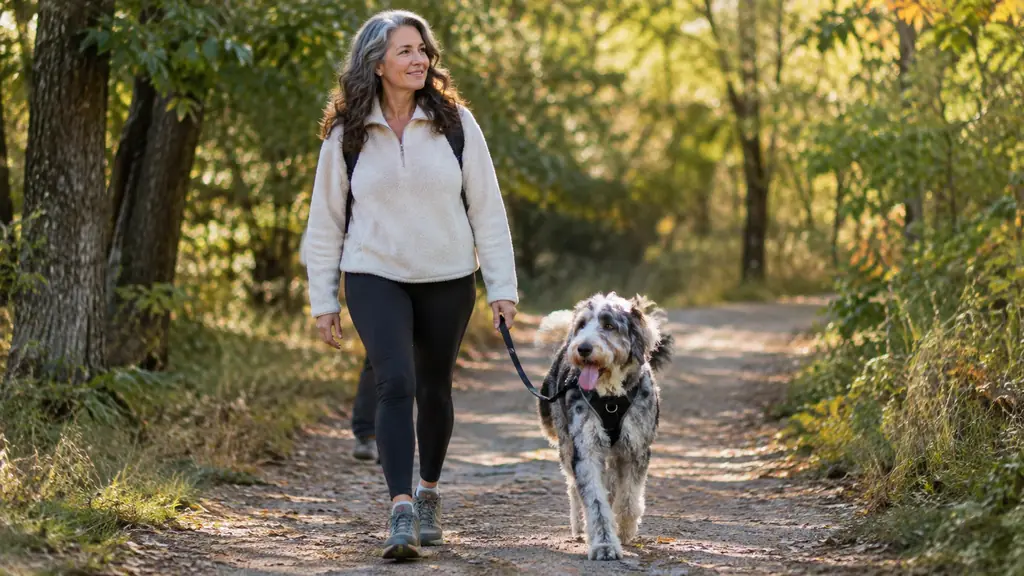
The back clip is not for pulling. It is for walks where you want to give the dog more freedom, like our weekend trail walks with my husband Dale. On the trail, June is allowed to range a little ahead, sniff the brush, and trot at her own pace. The back clip does not steer her the way the front clip does, and that is fine, because the trail is not where we are working on leash manners.
I think of it as two different tools on the same harness. Front clip for the neighborhood, where I need her close and focused. Back clip for the woods, where the whole point is that she gets to be a dog. Having both on one harness meant I never had to switch gear between walks, and the harness hung on its hook by the front door ready for whichever walk we were doing. On a Saturday morning in early fall, Dale and I took her to a trail with a creek crossing, and with the back clip she splashed through the water and circled back to check on us every few minutes. That is the walk the back clip is for.
One caution: if your dog still pulls hard, do not use the back clip for everyday walks. The back clip gives them more leverage, and it can make pulling worse while you are still in the training phase. Save it for when the front-clip walks are consistently calm, the way we did. We waited until June was about a year old before the back clip became a regular thing.
Step 4: Reward the loose leash, not just the absence of pulling
The harness stops the pulling from being rewarding, but you also want to make the right behavior rewarding. I carried a small pouch of treats on our morning walks for the first few months. Every time June walked beside me with a slack leash, even for a few steps, I marked it with a quiet yes and gave her a treat. I did not treat her for stopping a pull. I treated her for choosing to walk loose. The distinction matters, because a dog who only stops pulling when you yank the leash has not learned anything about what you actually want.
The timing matters more than the treat. The treat has to come the instant the leash is loose, not three steps later. If you are not sure you can time it, just say yes the moment you feel the slack and then treat. The word becomes the marker, and the dog starts to understand exactly which behavior earned the reward. I used tiny treats, about the size of a pea, so we could do a lot of repetitions without June getting a whole meal's worth of snacks on a 45 minute walk.
I also stopped walking forward when she pulled. The front clip turned her toward me, and I stood still until she looked at me and the leash relaxed. Then we moved again. It felt slow at first, like we were getting nowhere, but the message was consistent: pulling stops the walk, loose leash continues the walk. That consistency is what an Aussiedoodle, with all that intelligence, picks up on fast. June figured out within a few days that the pause meant she had to check in with me before we kept moving.
Step 5: Be consistent for a few weeks and let the routine do the work
There is no way around the boring part: you have to do it the same way every single walk. June pulled hardest from about five to twelve months old, which for us was spring through autumn of 2024. The rabbitgoo harness arrived in March of that year, and I used the front clip on every neighborhood walk, no exceptions. Dale walked her on weekends, and I showed him the same routine so we did not send her mixed signals. I even wrote the two rules on a sticky note by the front door: front clip for the neighborhood, stop when she pulls. It sounds silly, but it kept us both honest.
By the time June was about a year old, our morning walks were calm. Not perfect, because she is still a young, smart, bouncy dog, but calm. She still gets excited when she sees a deer or another dog, and the front clip still turns her back toward me in those moments. The difference is that it happens once or twice a walk now, not forty times. On a good morning we can do the whole loop with the leash hanging in a loose curve the entire way.
If you are two weeks in and still seeing pulling, do not assume the harness is failing. Check the fit first, then check your own consistency. Are you using the front clip every time? Are you stopping when she pulls? Are you rewarding the loose leash? In my experience, the routine is usually the missing piece, not the gear. Give the front clip a few honest weeks before you decide it is not working.
What Else Helps
A harness fixes the mechanics of pulling, but an Aussiedoodle also pulls because they have energy and a busy brain. June gets a 45 minute walk most mornings, backyard fetch in the evenings, and a treat puzzle on Saturdays while Dale and I watch college football. On days when she has had enough exercise and enough thinking, the leash is noticeably looser. On rainy days when she has had neither, she is a different dog. I noticed the pattern within the first month: the walks that started with ten minutes of fetch in the backyard always went better than the ones that started cold.
I also brush June three or four evenings a week, and I learned that the harness strap line can rub her armpit curls into tangles if I am not careful. A quick check after each walk, and a light mist of detangler before brushing, keeps that from becoming a matting problem. It is not something most harness guides mention, but for a curly-coated dog it matters. The strap line sits right where her coat is softest, so I make a point of running a comb through that spot a couple of times a week.
And if your dog is limping, showing skin irritation where the harness sits, or seems painful on walks, please ask your vet. I am not a trainer or a vet, and neither is any product page. A harness is a walking tool, not a treatment for anything.
The front clip turned her toward me the moment she pulled, and I stood still until the leash relaxed. Pulling stopped the walk. Loose leash continued the walk. That consistency is what an Aussiedoodle picks up on fast.
Give the front clip a few honest weeks
The rabbitgoo no pull harness is the one that made our walks calm again, and it is still on the hook by our front door today. If your Aussiedoodle is dragging you down the sidewalk, this is the tool I would start with.
Amazon Check Today's Price on Amazon →